
Looking Back and Looking Forward | Numbers part 36
Scripture Reading: 2 Peter 1:3-11
My family has adopted a habit when we go places. When we make a stop to visit a new city or state, we make sure to find a souvenir shop and buy a fridge magnet. I don’t remember when we started doing this. I just know my grandmother had a spoon collection with decorative spoons from all her travels. I always thought that was the coolest thing on her walls. Unfortunately, not too many places have decorative spoons anymore, but they sure have a bunch of magnets. So now, the kids get involved and discuss which magnet to buy. We have a lot! I also bought Brandy a chopping board in the shape of each state we have lived in as a couple.
Now, why do we buy such frivolous things?
It helps us remember where we’ve been. Each magnet is a testimony to God’s provision and grace that has allowed us to travel to all kinds of wonderful places. Each wooden state above our kitchen window is a reminder of the places that have formed our marriage—some of it good, some not so good.
I firmly believe it is worth remembering where God has led us.
As we come to Numbers 33, Moses is told to record all the places they have been. Why? Because it is worth remembering the journey.
We have noted before Numbers has a structure in which tables of information, laws from the Lord, and narratives of history are placed next to other. All three are used to tell the story of how God moved Israel from Mt. Sinai to the border of the Promised Land. (It won’t be until the Book of Joshua that we read about Israel crossing the Jordan into the Promised Land.) As we come to chapter 33, Moses records the travels of Israel during the wilderness journey. Chapter 34 will define the boundaries of the new nation. The last two chapters decide special cases concerning the allotment of land.
And so, though these chapters read a little anti-climatically for modern ears, the overarching point of the last four chapters is that “Israel is finally about to enter the land!”
So what will that new land look like?
For 32 chapters, Israel has longed for the Promised Land in a very abstract sense. It was always something “out there” waiting for them. Now that they have arrived, Moses will lead them to determine who gets what part. They are to allot the land according to the Lord’s instructions.
As we go through the next couple of chapters, we will once again read them in light of the Four Senses of Scripture because, as we will see, the principles for how Israel was to enter the land can absolutely inform how we are continue our own mission today.
Remembering the Lord’s Work | Numbers 33:1-4
These are the stages of the people of Israel, when they went out of the land of Egypt by their companies under the leadership of Moses and Aaron. Moses wrote down their starting places, stage by stage, by command of the LORD, and these are their stages according to their starting places. They set out from Rameses in the first month, on the fifteenth day of the first month. On the day after the Passover, the people of Israel went out triumphantly in the sight of all the Egyptians, while the Egyptians were burying all their firstborn, whom the LORD had struck down among them. On their gods also the LORD executed judgments.
Numbers 33:1-4
Moses writes down each stop on their 40 year journey. Notice, he doesn’t begin with this generation’s start. Their journey is part of their parents’ journey. Moses begins when Israel first left the city of Rameses the day after Passover. As the Egyptians were still burying their firstborn, mourning their destruction, Israel leaves triumphantly. Additionally, Moses notes it was the Egyptian gods that also faced judgements. Israelite freedom wasn’t a civic victory. It was spiritual.
Israel’s struggle was always primarily a spiritual battle.
In the following verses, Numbers gives a place by place run down of where the tribes were through their journey. You can see the whole route with this map.
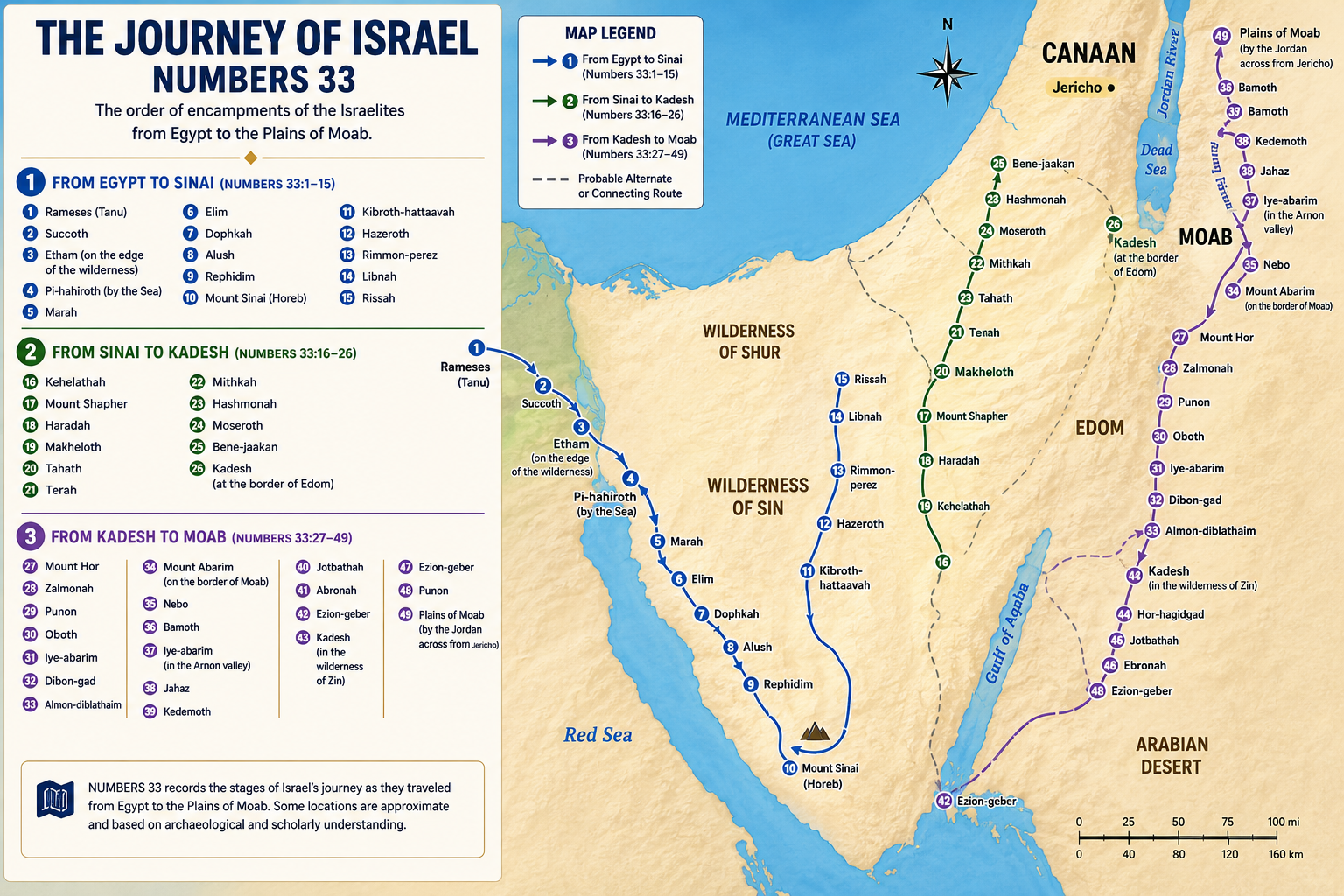
As you can see, the nation zigzagged its way through the Sinai peninsula and up to the northeast side of the Dead Sea. This recounting of the places they have been does two things: 1) it provides clarity for the nation’s journey, but more importantly 2) it is a reminder of what God has done throughout their 40 years. Each place is a reminder of God’s provision, protection, and in some cases punishment. It is 30 chapters and 40 years of wilderness journey put on a map dot by dot.
Now, how can we think about this journey for today?
First, it is always well worth remembering how far we have come—individually and as God’s people.
I know, I know. Some of you are already mentally checking out because somebody told you history was boring and you believed them. But here's what I want to push back on this morning.
History isn't boring. History is where God lives.
Our faith — Christianity — is not a philosophy. It's not a set of abstract ideas floating around in the clouds somewhere. It is a faith built on the foundation that God actually showed up in actual history and actually did things. The Exodus happened. The wilderness happened. The cross happened. The resurrection happened.
These are not myths or metaphors. These are events recorded in time and space that changed everything.
We really can learn from the past because God’s Truth does not change from century to century.
And, I would like to push this principle even closer to home. Our past may explain how we landed where we are, but it doesn’t have to dictate where we are going. Israel may have started as slaves in Egypt, but they were headed to an independent land that they would conquer. Yes, they couldn’t conquer it without the Lord’s help, but that’s kind of the point of the whole Bible—and the Gospel. Without the Lord, we are doomed to slavery, sin, and death. With the Lord, we are bound to freedom, a greater land, and eternal life.
Remembering where we have been can help us remember where we are going.
We are still in a spiritual battle, and, praise God!, that battle has an ending date. We may not know exactly when, but God has already shown us through His Word, there will be an end to our struggle with sin and death. Each time we look back to how God has already helped us overcome this struggle is even more evidence to the reality of this great promise.
But until that day comes, we have more work to do. So does Israel, so let’s keep going.
Remembering the Lord’s Mission | Numbers 33:50-56
And the LORD spoke to Moses in the plains of Moab by the Jordan at Jericho, saying, “Speak to the people of Israel and say to them, When you pass over the Jordan into the land of Canaan, then you shall drive out all the inhabitants of the land from before you and destroy all their figured stones and destroy all their metal images and demolish all their high places. And you shall take possession of the land and settle in it, for I have given the land to you to possess it. You shall inherit the land by lot according to your clans. To a large tribe you shall give a large inheritance, and to a small tribe you shall give a small inheritance. Wherever the lot falls for anyone, that shall be his. According to the tribes of your fathers you shall inherit. But if you do not drive out the inhabitants of the land from before you, then those of them whom you let remain shall be as barbs in your eyes and thorns in your sides, and they shall trouble you in the land where you dwell. And I will do to you as I thought to do to them.”
Numbers 33:50-56
This particular section is very interesting because as they are headed over the river, the Lord once again tells them they will have to drive out the inhabitants of the land. Yes, the land is theirs, but they still have the task of securing the land. God has given them the authority to take the land, but they have the responsibility of actually taking the land.
Even more, if they fail to complete the task, whatever groups remain will become barbs and thorns to them. They will bring trouble to Israel, and even worse, God’s punishment on the Canaanites will come on Israel.
Israel has the God’s blessing to take the land, but also a personal responsibility to secure it.
Once again, the principle for us today comes to light. First, we remember where we have been. Second, we remember our charge continues from the beginning of our salvation to the very end.
As we consider our own journey towards God’s destination for us, we can see both God’s grace and our responsibility. Consider this duality of grace and responsibility in how Paul describes our salvation in Ephesians 2.
For by grace you have been saved through faith. And this is not your own doing; it is the gift of God, not a result of works, so that no one may boast. For we are his workmanship, created in Christ Jesus for good works, which God prepared beforehand, that we should walk in them.
Ephesians 2:8-10
Paul is very clear our salvation is secured by the work of God through Christ Jesus. No one can boast that they somehow earned salvation or secured it through some great work, because it is a gift of God. You can’t earn a gift—that’s why it’s called a gift.
And yet, this gift has a purpose.
God prepared each of us for a purpose as a workmanship—the NIV translates it “handiwork.” God doesn’t accidentally make us or save us, He puts care and attention into it. And why so much attention? Because He has a job—“good works”—for us to do “that we should walk in them.” The following chapters in Ephesians describe what these “good works” look like, but the whole remaining letter is based on this duality of our salvation—grace and responsibility. Another way to think about it is this: our salvation is never about us alone. Our individual salvation has always been tied to the larger salvation that is the re-creation of this world. Just as Adam’s sin brought corruption to this entire world, so now does Jesus’ atonement bring salvation to this world.
Our salvation story is a part of the Grand Story of Redemption recorded in Scripture and seen in history.
God chose Israel to take this land because He will use Israel to bring about the Messiah. God chose you because you will be part in what God is doing today—reconciling all nations to Himself.
But both Israel’s and our salvation comes with a responsibility. We cannot allow the inhabitants to remain in the land. Now, obviously, we are not called to destroy lost people today. It’s difficult to tell someone about Jesus while trying to kill them. But, as we have talked about before, we are called to remove those things in our lives that will cause us trouble.
If Israel didn’t remove every last Canaanite, they would become a barb and a thorn to them. Guess what: they didn’t remove all the inhabitants. The Book of Joshua records their failure to uphold this end of the covenant. And, just as God warned, the inhabitants were a constant source of problems. Judges, Samuel, Kings, and Chronicles all describe the constant spiritual, civil, and physical disasters that plagued Israel because they failed to secure the Promised Land.
When we fail to remove sin from our own lives, that sin will continue to be a constant thorn that prevents us from growing as God intends.
The wisdom of Psalms declares:
Blessed are those whose way is blameless,
who walk in the law of the Lord!Blessed are those who keep his testimonies,
who seek him with their whole heart,Psalm 119:1-2
We are blessed when we seek the Lord with our whole heart and keep His commands. But how can we do that? Isn’t the Bible filled with people who knew better and yet failed? Yes, because the Bible is filled with stories of humans who, just like today, struggle with the temptations of this world. So what is the answer? Again, seek the Lord with our whole heart. And if we skip down to verse 11:
I have stored up your word in my heart, that I might not sin against you.
Psalm 119:11
We must store the Word of God in our hearts.
Now, before we return to Numbers, I want to take a quick detour. When Psalms says “your word,” which ‘word’ is it talking about? When I say “store the Word of God,” which word?
You see, this verse has a dual interpretation. First, we can confidently say the psalmist has in mind the Bible. This entire psalm recounts the blessings of reading and applying the Scripture, as well as the promises God makes in His Word. But connected with that is the second interpretation of “Word”—Jesus. John calls Jesus the “Word made flesh.” The Word that was with God and was God in the beginning took on flesh and dwelt among us, as he describes in John 1.
And so, fast forward to James in which he says,
Therefore put away all filthiness and rampant wickedness and receive with meekness the implanted word, which is able to save your souls.
James 1:21
It is when we receive the Word, and it is implanted in us that our souls are saved. In verse 18, James calls this word the “word of truth”.
Of his own will he brought us forth by the word of truth, that we should be a kind of firstfruits of his creatures.
James 1:18
Verse 18 sounds an awful lot like Ephesians 2:8-10. It is God’s will for us to be saved, and it is God’s will that our salvation leads to His design for our lives. Where Paul takes this concept to explain how Christians ought to live, James will take this same concept and explain if our faith does not compel us to a changed, productive life, then we should question whether we actually have faith.
And so, whether we are looking at Israel in Numbers, the wisdom of Psalms, Paul’s teachings for the Church, or James’ teachings for Christian life, the same pattern exists
God’s intention for humanity is to cleanse us of sin, so that we can live as He designed us to live.
This grand design to rid the world of sin brings us to the last principle for today. Before I say it, though, let’s take another look at what we’ve seen.
First, it is always well worth remembering how far we have come—individually and as God’s people. Remembering gives us encouragement. If others have overcome the same struggles I have, then that means there is hope for me. And even if my struggle really is only mine (it never is, though), I can look back and say, “If God can raise Jesus from the dead, then He can help me, too.”
Second, we remember our charge continues from the beginning of our salvation to the very end. Remembering where we came from also helps us remember where we are going. We weren’t saved to sit back and wait. We were saved to join in God’s mission to reach others—to minister, to evangelize, and to generally make this world a better place than how we found it.
Third, we remember God’s promise to make all things new. The Lord told Israel they were to take the land and create a base of operations where God would bless all the nations. Abraham was promised his family would be a blessing to all nations. Abraham’s family became the nation of Israel. And Israel became the place where Jesus dwelt on the earth. That promise to be a blessing to all nations continues to be fulfilled even today as more and more people follow Christ. Each new Christian is one more missionary given the task to tell and demonstrate the love of God that overcame sin and death through Jesus Christ.
And one day, when Christ returns, we will join with Him in reaching the Ultimate Promised Land. We won’t have to struggle and fight with sin anymore because Heaven and Earth will unite in the New Creation, and where Israel failed to remove sin, Jesus will not fail.
As we remember these truths of history, will you join God in His mission?
It begins with our own heart, first. Receive the Word today and begin the process of removing sin in your life.
But don’t stop there! Because the real fun starts when you walk in the way the Lord leads towards good works and showing others how they can remove sin and death from their lives, too.