
Defining the Boundaries of the Promised Land | Numbers part 37
Scripture Reading: 1 John 5:1-5
Have you ever tried cooking eggs in a microwave?
I have heard stories of people doing this. I don’t get it, personally. I will not judge you, if you are one of those people…but I will judge your eggs. I don’t consider myself an egg-snob, but I do have a crafted approach, so maybe I am.
I suppose microwaved eggs are still better than some breakfast alternatives, or not eating breakfast at all. But if I have my druthers, I’d rather have a carefully cooked breakfast made on a seasoned skillet rather than anything that comes out of a microwave…or a cellophane wrapper.
I’ve noticed, however, life has a way of getting in the way of my breakfast. Rarely do I get to make pancakes, bacon, and eggs. Most days I’m headed to Casey’s for a breakfast sandwich and a fountain drink. It’s nowhere near the same (nor as healthy), but here we are.
I’ve noticed for many of us, our Bible study tends to be the same way. If we get around to it at all, we tend to choose the quick route. “God, just give me the quick tip I need for the day, so I can get to work.” The problem with this approach isn’t that it is all bad. You are still being fed. It’s just not exactly a full course meal for your soul. Studying the Bible this way here and there is one thing, but if your constant diet is this way, it is much like feeding on fast food every day. Sure, you ate, but are you really healthy?
This week we are looking at a chapter that can very easily be a “just give me the quick facts, and let’s move on” type of chapter. We are looking in the final section of Numbers with the boundaries of the tribes within the Land, who the leaders for the tribes will be, and finally which areas are to be marked for the Levites. These could be sections we might want to skip, but what if we slow down?
Again, I believe it is far more fruitful to approach the text using the Four Senses of Scripture in order to understand what the Lord is telling us today. As a refresher, the Four Senses are:
Literal - What does the Bible actually say?
Typological - What does the text teach us about God?
Tropological - What does the text teach us about holiness?
Anagogical - What does the text teach us about what God is doing?
The Four Senses work together to move us from the Bible’s original context to today and then on to what God is going to do in the future. It is important to take this approach altogether because, if we take only one or two, we may find ourselves in error.
For example, and by way of introducing our text today, let’s consider the boundaries of Israel described in Numbers 34. The literal meaning is pretty straightforward. It lists the markers for where the nation is to be. There is some debate about whether Israel ever actually had these borders, but much of that debate centers around the facts found in the Book of Joshua. Israel fails to drive out the inhabitants of the land, and so the local Canaanite groups continually are problems for Israel.
But let’s take it a step further. Does this mean Israel will always have these borders? And if not, does that mean we are in error (or worse sin) if we do not allow Israel to have these boundaries? There are Zionists, both Jewish and Christian, that would say ‘yes.’
But then, how do we reconcile this interpretation with the New Testament’s call for all nations to join the Kingdom of God?
What about when Jesus says His Kingdom is “not of this world?”
Can we even still call the Jewish people “God’s People” when they have rejected God’s Son?
Unfortunately, each of these questions could garner its own sermon, but my point is simply this:
Reading Scripture deeply and holistically helps us to avoid the error of bad interpretation.
Rather than asking how this text can prove my pre-conceived notions, I can ask how this text draws me closer to God’s Kingdom and ultimate purpose for this world. Yes, it requires us to slow down, and yes, it requires us to study more. But studying the Bible is a lot like cooking dinner. Sure, you can find quicker methods, but they won’t be near as delicious or satisfying as taking your time to do it right.
Let’s take a look.
Defining the Promised Goal | Numbers 34:1-15
The LORD spoke to Moses, saying, “Command the people of Israel, and say to them, When you enter the land of Canaan (this is the land that shall fall to you for an inheritance, the land of Canaan as defined by its borders), your south side shall be from the wilderness of Zin alongside Edom, and your southern border shall run from the end of the Salt Sea on the east. And your border shall turn south of the ascent of Akrabbim, and cross to Zin, and its limit shall be south of Kadesh-barnea. Then it shall go on to Hazar-addar, and pass along to Azmon. And the border shall turn from Azmon to the Brook of Egypt, and its limit shall be at the sea.
“For the western border, you shall have the Great Sea and its coast. This shall be your western border.
“This shall be your northern border: from the Great Sea you shall draw a line to Mount Hor. From Mount Hor you shall draw a line to Lebo-hamath, and the limit of the border shall be at Zedad. Then the border shall extend to Ziphron, and its limit shall be at Hazar-enan. This shall be your northern border.
“You shall draw a line for your eastern border from Hazar-enan to Shepham. And the border shall go down from Shepham to Riblah on the east side of Ain. And the border shall go down and reach to the shoulder of the Sea of Chinnereth on the east. And the border shall go down to the Jordan, and its limit shall be at the Salt Sea. This shall be your land as defined by its borders all around.”
Moses commanded the people of Israel, saying, “This is the land that you shall inherit by lot, which the LORD has commanded to give to the nine tribes and to the half-tribe. For the tribe of the people of Reuben by fathers’ houses and the tribe of the people of Gad by their fathers’ houses have received their inheritance, and also the half-tribe of Manasseh. The two tribes and the half-tribe have received their inheritance beyond the Jordan east of Jericho, toward the sunrise.”
Numbers 34:1-15
We noted a few weeks ago, the borders outlined here are actually larger than what Moses may have intended. Throughout Numbers, the goal has always been to take the land between the Jordan River and the Mediterranean. Now, Reuben, Gad, and Manasseh have their land on the east side of the Jordan, and the rest of the tribes will have larger portions on the west side.
Again, the literal meaning of this passage is fairly straightforward. Unless you are familiar with these sites, it may be difficult to visualize, so here is a map that may help.
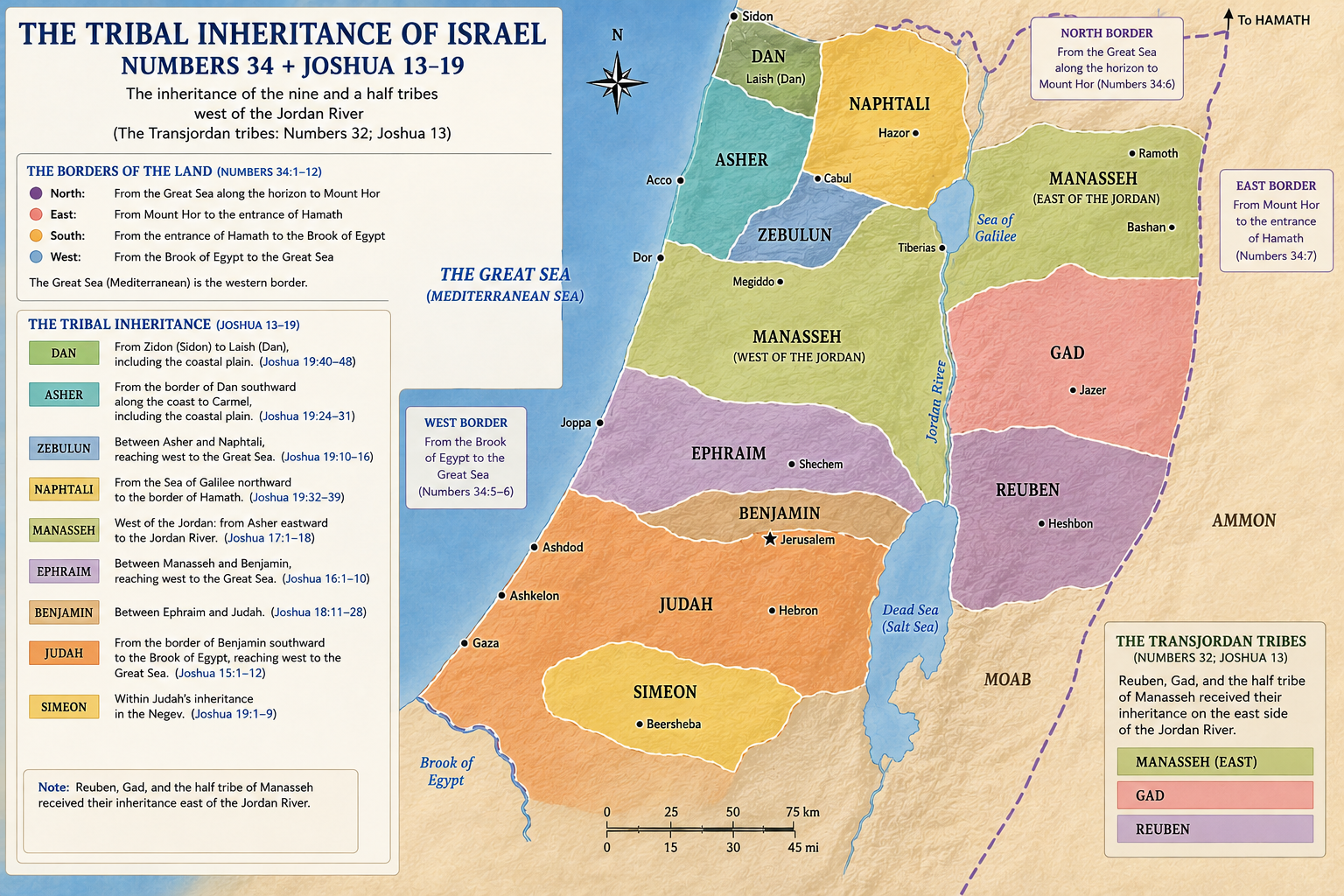
As we think about this typologically, we can ask, “What does this tell us about God?” Or “How does the text point us to Christ?” The first thing that stood out to me was how concrete the plan becomes. When the Lord defines the border, He doesn’t give arbitrary or vague borders. “From this town to this town, draw a line. That’s the boundary.” They are given some freedom within the boundaries to decide how much each tribe receives, but the overall structure is defined.
This pattern of “Here’s the boundary. Have fun and be creative within this boundary” is a common pattern in the Bible. Adam and Eve were given a Garden and told, “Eat whatever you want and tend to everything in the Garden, just don’t eat from the one tree.” Here, Israel is given the land and the borders. They are to tend to the land freely, so long as they keep the covenant. When we examine food laws (whether Old or New Testament), morality ethics, ecclesiology, and a myriad of other topics, the Bible will always present the boundaries, or the design for the topic, and then allow for creative endeavors within those boundaries.
Even when we fast forward to Revelation and see a picture of Heaven and the New Creation, we aren’t given a whole lot of details for daily life. We have a broad stroke picture of what is to come. We know we will serve the Lord and see Him face to face, but beyond that…who knows.
This heavenly view skips a step in the Four Senses, but it leads me to my point about this passage and looking at it tropologically, or morally.
The Lord’s commands are never about defining legalistic ethics, but rather defining the boundaries of holy living.
We will return to this point in a bit, but for now, notice once again, God doesn’t give a lot of specifics for inside the land. What is specified is where the boundaries for the nation will be. There is a massive difference between those two things, and it is worth pausing on.
Legalism says: "Here is the fence. Do not touch the fence. Do not look at the fence. Do not think about the fence. The fence is the point."
Holiness says: "Here is the fence. Everything inside it is yours — explore it, enjoy it, tend it, build something beautiful in it. The fence exists so that you can flourish, not so that you can be afraid."
God does not give Israel a border so He can punish them for crossing it. He gives Israel a border so they know where home is.
I think a lot of us have a distorted picture of God's commands. We grew up hearing "thou shalt not" so many times that we started to hear God as someone standing at the edge of the property with a clipboard, waiting for us to step out of line. But that is not the picture Scripture gives us. The picture Scripture gives us is a Father who has prepared a home — a land — and is inviting His children to live fully within it.
The commands are not the cage. They are the address.
Selecting Leaders to establish the Land | Numbers 34:16-18 & 29
The LORD spoke to Moses, saying, “These are the names of the men who shall divide the land to you for inheritance: Eleazar the priest and Joshua the son of Nun. You shall take one chief from every tribe to divide the land for inheritance.
…
These are the men whom the LORD commanded to divide the inheritance for the people of Israel in the land of Canaan.
Numbers 34:16-18 & 29
Next, the Lord gives the names of the tribal leaders. They will represent the tribes in front of Moses as the land is divided among them. This particular section is fairly straightforward again. It reads similar to the census lists because, like those, it is more a table of information than anything else.
Now, this relates to our previous point concerning the Lord’s commands. God gives the boundaries of holiness and then will raise leaders to help us navigate those boundaries. The job of these men was fairly simple—help allocate the land for each tribe.
Eleazar the priest. Joshua the son of Nun. One leader from every tribe. These are the men responsible for ensuring that the division of the land is done fairly, orderly, and in accordance with God's design. And anyone who has ever tried to divide a family estate among multiple heirs knows that this is not a simple task. Land division is emotional. It is political. It is the kind of thing that can fracture a family for generations if it is handled poorly.
God appoints leaders precisely because He knows that navigating within the boundaries of holiness is not always simple.
God appoints leaders in the community of faith to help us navigate within the boundaries of holiness.
This connects directly to our tropological question — what does this text teach us about holy living? And the answer here is that holy living is not a solo project. It requires community. It requires leadership. It requires people who are specifically appointed and equipped to help the rest of the body navigate wisely within God's design.
This reason is why it is absolutely essential to have qualified, godly leaders in the church and family. If the community has poor leadership, then it will lead the rest of the community into unholy practices. The rest of the Old Testament is story after story of poor leadership being called out by God and His prophets.
Paul says it this way in Ephesians:
And he gave the apostles, the prophets, the evangelists, the shepherds and teachers, to equip the saints for the work of ministry, for building up the body of Christ, until we all attain to the unity of the faith and of the knowledge of the Son of God, to mature manhood, to the measure of the stature of the fullness of Christ,
Ephesians 4:11-13
The role of church leaders is not to “do all the work” but to help the church, as a whole body, do ministry and grow in maturity. And it is in this role, we also see the link to the Levites of chapter 35.
And here is why I want to press on this for a moment, because I think it applies directly to where we are as a church right now. We talk a lot about the importance of small groups — of people gathering in homes and living rooms and coffee shops to study Scripture together and do life together. And we mean it. We believe it. But here is the thing: small groups are only as healthy as their leaders.
The tribal leaders in Numbers 34 were not asked to be perfect. They were not asked to have all the answers before they started. They were asked to show up, be faithful to the task God had given them, and represent their people well. That is exactly what we are asking of small group leaders today. You do not need a seminary degree. You need a willing heart, a love for God's Word, and a genuine care for the people sitting in your living room.
If you have been sensing a nudge toward leading — toward stepping into that role in someone's life — I want to encourage you to pay attention to that. We will talk more about what that looks like practically in just a moment.
Cities for the Levites | Numbers 35:1-8
The Lord spoke to Moses in the plains of Moab by the Jordan at Jericho, saying, “Command the people of Israel to give to the Levites some of the inheritance of their possession as cities for them to dwell in. And you shall give to the Levites pasturelands around the cities. The cities shall be theirs to dwell in, and their pasturelands shall be for their cattle and for their livestock and for all their beasts. The pasturelands of the cities, which you shall give to the Levites, shall reach from the wall of the city outward a thousand cubits all around. And you shall measure, outside the city, on the east side two thousand cubits, and on the south side two thousand cubits, and on the west side two thousand cubits, and on the north side two thousand cubits, the city being in the middle. This shall belong to them as pastureland for their cities.
“The cities that you give to the Levites shall be the six cities of refuge, where you shall permit the manslayer to flee, and in addition to them you shall give forty-two cities. All the cities that you give to the Levites shall be forty-eight, with their pasturelands. And as for the cities that you shall give from the possession of the people of Israel, from the larger tribes you shall take many, and from the smaller tribes you shall take few; each, in proportion to the inheritance that it inherits, shall give of its cities to the Levites.”
We will return to the topic of “city of refuge” next week, but for this week, I want to point out how many cities there were and how they are scattered throughout Israel. Notice the total number is 48 cities.
I had a “duh” moment this week in studying, because I thought “I wonder why it’s 48 and not 49.” 49 would be 7 sevens—perfected perfect number, right? When I looked it up, the math became really obvious. It’s four cities for the twelve tribes. Each tribe had a city in the North, South, East, and West of their region.
Sometimes the simplest answer really is the best answer—no numerology or metaphysical philosophy needed.
And so, when we think about the role of the Levites, the geographic spread of the Levites, and their cities that functioned as their inheritance in the Promised Land, the simplest principles really make the most sense here.
The role of the Levites provide a template for church leadership today.
The Levites were the adjudicators and teachers of the Law. It was their job to ensure the people understood what God had commanded and how to keep the peace in the land.
The Levites were spread throughout the 12 tribes in order to be accessible to the people when they were needed outside the “normal working hours.”
The Levites had their own cities that were places of refuge for those accused of criminal offenses. Again, this point will be the topic of next week, but for now, the city of refuge was where someone accused of a capital crime could go to be sure they had a fair hearing.
And so, for those who are in leadership, or hope to be one day, let’s consider how these Levite principles apply to today.
Can you teach God’s Word?
The primary qualification for an elder — and, I would argue, for a small group leader or anyone in a teaching role in the church — is the ability to teach. And as we all know, we cannot teach what we do not know. There are two errors we tend to fall into at this point.
The first error is not knowing enough to teach. We have neglected study, we have let our Bibles gather dust, and now we find ourselves spiritually malnourished and unable to feed anyone else. The remedy for this error is straightforward: study. Paul's instruction to Timothy was to "study to show yourself approved" — to be a worker who does not need to be ashamed, who handles the Word of truth accurately. That takes time. It takes the kind of intentional, sit-down-with-your-Bible-and-actually-dig study that feels more like cooking a real breakfast than grabbing something from a drive-through.
The second error — and this one is just as common — is believing that you don't know enough. You have been studying. You have been in the Word. You have been growing. But every time someone suggests you might be ready to lead, you say, "Oh, I'm not qualified yet. I need to know more." And so you wait. And wait. And wait.
Here is the truth: what you know, you can teach. You do not have to know everything to begin. You just have to know something, and be willing to share it honestly with others. Should you keep studying? Of course. But we cannot allow the pursuit of perfection to prevent the progress God is calling us to make. Begin where you are. Keep moving forward.
Are you accessible to others?
The other qualifications for an elder — and for deacons, small group leaders, and virtually every other functional role in the church — have to do with character. Hospitality. Approachability. Humility. Gentleness. These are not personality traits you either have or don't have. They are practices. They are habits. They are the daily choices to be the kind of person that others actually want to be around.
It is very difficult to lead people who would rather not have anything to do with you. And the opposite error — being so eager to be liked that you never say a hard thing or hold a difficult line — is just as problematic. The only One we truly need to please is the Lord. But the Lord does call us to be kind, gentle, patient, and genuinely present with the people He has placed in our lives.
The Levites were not just strategically located. They were expected to be available when people needed them. Accessibility is not just geography — it is posture.
Can you be fair in judgements?
Throughout Scripture, the Lord is unambiguous: He does not play favorites. And just as clear is the mandate for His people to follow suit. The Levites had to adjudicate the Law fairly — regardless of a person's social standing, their family connections, or how much land they owned. Justice, in Israel, was not supposed to be available only to the powerful.
Likewise, leaders within a local church body are called to navigate conflict and make decisions fairly — regardless of a person's title, their tenure at the church, or how much they give. This is harder than it sounds. We are all prone to unconscious favoritism. We naturally gravitate toward people who are like us, who agree with us, who make our lives easier. Leadership requires the discipline to resist that pull and to treat every person in the community with the same dignity and fairness that God extends to all of us.
Let me pull all three sections of this passage together, because I think there is one overarching truth that ties Numbers 34 and 35 into a single, coherent picture.
God defines the boundaries. God appoints the leaders. God distributes the resources throughout the community. And in all of it, the goal is the same: that His people would flourish within the life He has designed for them.
The borders of the Promised Land were not a limitation. They were a gift. They were the shape of home.
The appointed leaders were not a burden. They were a gift. They were the people God raised up to help the community navigate wisely within the life He had given them.
The Levite cities scattered throughout the land were not an administrative footnote. They were a gift.
They were God's way of ensuring that no tribe, no family, no individual would ever be too far from someone who could help them understand His Word and find their footing within His design.
And here is what I want you to carry out of this room today.
The commands of God are not a cage. They are an address. They tell you where home is.
The leaders God places in your life — pastors, elders, small group leaders, mentors — are not authority figures to resent or perform for. They are people God has appointed to help you navigate wisely within the life He has called you to.
And the community God has placed you in — this church, these people — is not a social club or a Sunday obligation. It is your tribe. It is the community within which you are meant to flourish, to be known, to be led, and to lead others.
Which brings me to something I want to say directly before we close.
We talk often about the importance of small groups — of people gathering together to study Scripture, to pray, to do life in genuine community. And I believe in it deeply. But community does not happen automatically. It requires people who are willing to step up and lead it. Not perfectly. Not with all the answers. Just faithfully.
If you have been sensing that nudge — that quiet sense that maybe God is calling you to lead a group, to open your home, to invest in a few people more intentionally — I want to ask you to take one concrete step this week. Talk to one of our elders. Fill out a connection card. Come find me after the service. We are not asking you to have it all figured out. We are asking you to be willing to begin.
The Levites were distributed throughout the land so that no one would be without access to someone who could help them understand God's Word and navigate God's design. That is exactly what small group leaders do in a local church. And we need more of them.
We started this morning talking about eggs.
Specifically, we talked about the difference between a meal that was made with patience and care and something you grabbed on the way out the door because life was moving too fast to slow down.
The chapters we looked at today — Numbers 34 and 35 — are exactly the kind of chapters that most of us would skim past on our way to something more interesting. A list of borders. A list of names. A list of cities. Move along, nothing to see here.
But when we slow down — when we sit with the text and ask not just what it says but what it teaches us about God, about holiness, about what He is doing in the world — we find something genuinely nourishing. We find a God who defines the boundaries of our lives not to restrict us but to give us a home. A God who raises up leaders not to do the work for us but to equip us to do it together. A God who distributes His resources throughout the community so that no one is ever too far from help, from truth, from belonging.
That is not a God to be afraid of. That is not a God whose commands feel like a cage. That is a Father who has prepared a land — a life — and is inviting His children to live fully within it.
And for anyone here today who is not yet inside that life — who is still on the outside of the boundary looking in, wondering if there is a place for you — I want you to hear this clearly.
There is.
The invitation of the gospel is not complicated. Jesus came to seek and to save the lost. He came so that we might have life, and have it abundantly. He gave everything — His life, His body, His blood — so that the boundary of God's family would be wide enough to include you. All you have to do is come.
Come out of the wilderness. Come into the land.
There is room for you here.