
Zeal and Fidelity | Numbers part 28
Scripture Reading: 1 Corinthians 10:1-13
For the last three sessions, we have looked at Balaam’s story with the overarching principle “God is sovereign and will not be manipulated.” Today, the story of Numbers shifts back to Israel as they learn God’s Sovereignty also means He will not be mocked.
The very first Commandment is:
“I am the Lord your God, who brought you out of the land of Egypt, out of the house of slavery. “You shall have no other gods before me.
Exodus 20:2-3
The phrase “before me” is ‘al penai and is a flexible phrase in Hebrew. Literally, it would be “in my face” but depending on the context could be “in my face”, “in front of me”, “against me”, or even “beside me.” No matter which phrase you choose, this command works.
You shall have no other gods in my face.
You shall have no other gods in front of me.
You shall have no other gods against me.
You shall have no other gods beside me.
Yahweh, alone, is your God, and no other god is equal to Him. It is the same lesson Balaam and Balak had to learn. There is no god like Yahweh. There is no god like the God of Israel. And if we back up a bit, who was it that brought Israel out of the land of Egypt? Yahweh.
Ancient Israel lived in a time not so different from our own. A plethora of gods existed for Israel to choose from. Egypt, where they lived as slaves for 400 years, had a pantheon of gods they could choose from. But it was not a god in Egypt that brought them freedom.
Today, we also have a pantheon of gods to choose from—and not just the traditional variety. There are a myriad of powers and systems that ask for your allegiance.
But who brought you freedom?
Who can forgive sin and give eternal life?
Which ‘god’ in this world is actually worth serving?
Today, we will read where the Israelites learn the price for breaking the First Commandment, and it is based on this simple principle:
The Lord alone is to be worshipped because the Lord alone is worthy to be worshipped.
Infidelity in Israel | Numbers 25:1-9
While Israel remained at Shittim, the people began to commit infidelity with the daughters of Moab. For they invited the people to the sacrifices of their gods, and the people ate and bowed down to their gods. So Israel became followers of Baal of Peor, and the Lord was angry with Israel. And the Lord said to Moses, “Take all the leaders of the people and execute them in broad daylight before the Lord, so that the fierce anger of the Lord may turn away from Israel.” So Moses said to the judges of Israel, “Each of you kill his men who have become followers of Baal of Peor.”
Then behold, one of the sons of Israel came and brought to his relatives a Midianite woman, in the sight of Moses and in the sight of the whole congregation of the sons of Israel, while they were weeping at the entrance of the tent of meeting. When Phinehas the son of Eleazar, the son of Aaron the priest, saw it, he rose up from the midst of the congregation and took a spear in his hand, and he went after the man of Israel into the inner room of the tent and pierced both of them, the man of Israel and the woman, through the abdomen. So the plague on the sons of Israel was brought to a halt. But those who died from the plague were twenty-four thousand in number.
Numbers 25:1-9
Moab is the same Moab in which Balak was king. The narration skips a section of the story from Balak’s point of view, but it would appear that instead of sending his army to kill the Israelites, Balak opted to allow his people to interact with Israel. The Moabites worshiped the god, Kemosh, primarily, and worship practices included sacrifices (as seen in Numbers 23-24) and possibly human (child?) sacrifice as seen in 2 Kings 3. Here, it would appear cultic temple worship also included sexual acts—a common feature of many pagan religions.
Thus, the level of immorality is two-fold. The men are not only engaging in relations outside their marriages, they are also worshipping foreign gods. The penalty for either of these crimes is death. The Lord tells Moses to execute the perpetrators in daylight so that all of Israel will see the punishment. Moses delegates this duty (there were 24,000 offenders) to judges.
Then, the narration tells us a particular Israelite, named later Zimri, brings a Moabite woman in the “sight of the tent of meeting” while Moses and the judges are actively weeping for what is to happen. This level of disobedience is not accidental. Zimri is deliberately defiling the tabernacle area.
Remember the layout of the tabernacle. It had linen walls all around the area that were about 7.5’ tall. The tent of meeting itself, consisting of the Holy Place and Holy of Holies was within these walls. When Phinehas catches up with them, they are apparently within the tabernacle itself because it says Phinehas went after them into the inner room of the tent. Zimri has brought the Moabite consort within the tabernacle to engage in elicit acts—possibly as they did in the Moabite temple.
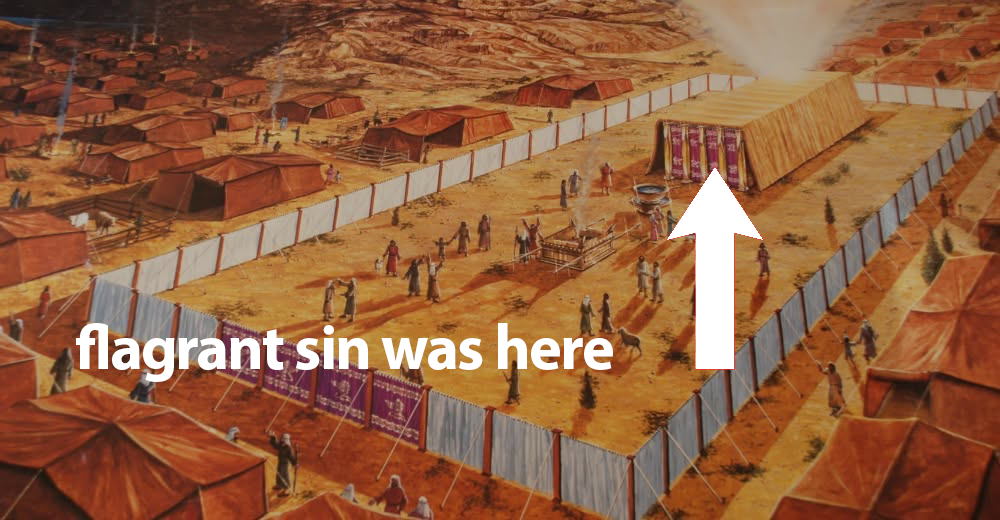
Zimri’s sexual immorality was in the tent. (Numbers 25:8)
How often did the Lord warn the priests and the people to maintain the integrity and holiness of the tabernacle? How many times did the Lord send plagues and death upon the Israelites because of their sin?
Phinehas wastes no time in carrying out this couple’s punishment.
Zimri’s sin is a flagrant disregard for God’s commands and the tabernacle’s holiness.
The remaining offenders would die from plague, or possibly stroke. Again, the Hebrew here is a general term, but it does signify a quicker death. In 1 Corinthians 10, Paul references a series of divine punishments including this one stating 23,000 died in a single day. Jewish tradition holds Moses’ judges executed 1000 of the offenders, and the plague killed 23000.
Regardless, the point is simply that 24,000 Israelites lost their lives from their sin.
The Zeal of Phinehas | Numbers 25:10-18
Then the Lord spoke to Moses, saying, “Phinehas the son of Eleazar, the son of Aaron the priest, has averted My wrath from the sons of Israel in that he was jealous with My jealousy among them, so that I did not destroy the sons of Israel in My jealousy. Therefore say, ‘Behold, I am giving him My covenant of peace; and it shall be for him and for his descendants after him, a covenant of a permanent priesthood, because he was jealous for his God and made atonement for the sons of Israel.’”
Now the name of the dead man of Israel who was killed with the Midianite woman, was Zimri the son of Salu, a leader of a father’s household among the Simeonites. And the name of the Midianite woman who was killed was Cozbi the daughter of Zur, who was head of the people of a father’s household in Midian.
Then the Lord spoke to Moses, saying, “Be hostile to the Midianites and attack them; for they have been hostile to you with their tricks, with which they have deceived you in the matter of Peor and in the matter of Cozbi, the daughter of the leader of Midian, their sister who was killed on the day of the plague because of Peor.”
Numbers 25:10-18
Phinehas is credited for making atonement for the sons of Israel. It is absolutely worth pausing here. What was required for atonement? It was death. Death was needed if the nation of Israel was to be saved and to be right with God again. The sinners themselves had to pay the price. Phinehas pays that price, but not with himself.
Atonement requires sacrifice. The wages of sin is death. In order for humanity to be saved, there must be a payment of blood. This is why Jesus’ sacrifice is such Good News. If my sin is to be atoned for, I must die. But, if I die in my sin, then only condemnation awaits. Jesus was able to pay the price and still live because He was the only sinless human. He did not need to atone for his own sin—such sin does not exist. And yet, He was willing to go to the cross on our behalf.
Sin leads to death, and demands death, for the same reason holiness leads to life, and demands life. It is the difference between two masters. For the sinner who chooses sin, they are obeying the Serpent from way back in Genesis 3. They choose the forbidden tree that leads to death. For the one who chooses holiness, they are obeying the Creator Lord who gives life. But, in order for the sinner to move to holiness, all their sin must be removed. This only happens with the shedding of blood.
Indeed, under the law almost everything is purified with blood, and without the shedding of blood there is no forgiveness of sins.
Hebrews 9:22
Phinehas sheds blood in order to remove the blight of Israel’s sin from the nation.
Then, the Lord gives the command to attack the Midianites because of their acts against the nation. This retaliation will not occur until Numbers 31 after a series of chapters in which the people are reconsecrated before the Lord. The next few chapters will reset the nation again.
Before we close today, I would like to spend some time with a pertinent question:
How do we deal with violence in God’s people of Israel?
Violence In the Bible
In preparation for this week, I was struck by Phinehas’ actions and how the Bible praises his violence. When we read ahead in Numbers 31, the violence escalates to an uncomfortable level. So, how do we address this violence?
In my first year of college, I took a class on Biblical Ethics. When we came to the topic of holy war, the professor asked us, “How do you reconcile the God of faith, hope, and love with the Old Testament commands to raze cities to the ground including killing every man, woman, and child?” The lack of response was telling. The professor wasn’t sure if we didn’t understand or if we just didn’t have a problem with it. Looking back, it occurs to me that most of us had heard the stories so much, we just didn’t think about it too much.
As I encountered more and more lost people in my life, I realized I needed to think about it more.
Holiness entails purification. That which is unholy must be removed in order for the object, or person, to be holy.
Holiness requires the purging of sin and its effects.
As Christians, we have no problem with violent imagery when it comes to sin. Paul calls Christians to “crucify the flesh” in Galatians 5.
And those who belong to Christ Jesus have crucified the flesh with its passions and desires.
Galatians 5:24
Think about this picture. Paul says those who belong to Christ take their fleshly desires, their physical limitations and failures, and all that draws them away from Christ making them unholy and nails it to the cross—just as violently and graphically as Christ Himself went to the cross.
When Jesus was asked about entering the Kingdom of Heaven, He said it is better to go to heaven maimed rather than hell whole.
If your right eye causes you to sin, tear it out and throw it away. For it is better that you lose one of your members than that your whole body be thrown into hell. And if your right hand causes you to sin, cut it off and throw it away. For it is better that you lose one of your members than that your whole body go into hell.
Matthew 5:29-30
It’s worth noting Jesus says this about lust—a sin I believe we take too lightly today. Likewise, in the same passage in which he tells us entering the kingdom of heaven requires us to be like a child, he also gives warning to those who would cause children to sin.
Whoever receives one such child in my name receives me, but whoever causes one of these little ones who believe in me to sin, it would be better for him to have a great millstone fastened around his neck and to be drowned in the depth of the sea.
Matthew 18:5-6
Every time I preach this verse I explain it the same way: Jesus says if you hurt children, if you cause them to sin because of how you treat them, it would be better to go kill yourself. And every time I say that, people flinch and get uncomfortable. They should! It is a violent declaration of God’s holy standard.
If Jesus is this serious about sin, then why do we flinch at the stories of Israel’s Conquest?
I think, partially, it is because we are so used to excusing our own sin, we see ourselves in the pagans and fallen Israelites. And we should. When Paul says “All have fallen short of the glory of God,” we are in that “all.” It is by grace that we are not consumed like the Midianites. And, yes, that grace is extended towards all people through Christ, but if we reject Christ, if we continue in our sin, then condemnation still stands—and condemnation is violent.
This principle brings us full circle, from Genesis 3 to Numbers 25, and into the New Testament. The Lord sets before us life and death. It is up to us to decide. From the Garden to the Second Coming, the Lord is gracious to offer life, but that life is a holy life. It does not allow for sin because sin is not living. It is dying.
The same God who condemned the offending Israelites and Moabites to death is the same God who promised to do what no other god could—bring freedom from sin.
In the midst of Israel’s darkest hour, as they scattered out of the Promised Land and into foreign nations, the Lord made this promise through Ezekiel.
And the word of the Lord came to me: “Son of man, your brothers, even your brothers, your kinsmen, the whole house of Israel, all of them, are those of whom the inhabitants of Jerusalem have said, ‘Go far from the Lord; to us this land is given for a possession.’ Therefore say, ‘Thus says the Lord God: Though I removed them far off among the nations, and though I scattered them among the countries, yet I have been a sanctuary to them for a while in the countries where they have gone.’ Therefore say, ‘Thus says the Lord God: I will gather you from the peoples and assemble you out of the countries where you have been scattered, and I will give you the land of Israel.’ And when they come there, they will remove from it all its detestable things and all its abominations. And I will give them one heart, and a new spirit I will put within them. I will remove the heart of stone from their flesh and give them a heart of flesh, that they may walk in my statutes and keep my rules and obey them. And they shall be my people, and I will be their God. But as for those whose heart goes after their detestable things and their abominations, I will bring their deeds upon their own heads, declares the Lord God.”
Ezekiel 11-14-21
That promise was fulfilled through Jesus Christ. Through faith in Jesus, we can have God’s Spirit within us. The Spirit of God gives life and directs our steps causing us to walk in His statutes. We don’t obey the Lord so that He will love us. We obey the Lord because He loves us and sent His Son to be the sacrifice that we could not be. He paid the price we could not pay.
Many of us have been just like Zimri flagrantly sinning before the face of God, but God rich in mercy sent His Son so that we could be forgiven. We can still be a holy people because Jesus is the Way to holiness.
Through Christ our sin can be purged and the violence of sin ended.
As we reflect on the promise of 1 Corinthians 10, on the teaching of Numbers 25, and most importantly the First Commandment of Exodus 20, we are reminded that Life and Death are set before us. We can choose Jesus, the Way, the Truth, and the Life, or we can choose sin.
But we cannot choose both.