
Victory in Jesus - part 2 | Palm Sunday
This week we continue our look at the question, “How does Jesus dying on the cross save us?” This Sunday is also Palm Sunday in which we celebrate Jesus’ entrance into Jerusalem as the King who brings peace. In the passage we just read, the people proclaim, “Hosanna to the Son of David! Blessed is he who comes in the name of the Lord! Hosanna in the highest!”
“Hosanna” means “save, we pray.” It is a proclamation of praise and joy that invokes a military victory over enemies. When we couple this phrase with “Blessed is He who comes in the Name of the Lord,” we are very much supposed to understand the people see Jesus as a conquering hero. And yet, in verse 11, we read that many in the crowd called him “the prophet Jesus.” His identity as the Messiah was still debated, though the disciples closer to him knew.
Likewise, Jesus comes riding on a donkey. In the ancient world, a king would ride into a city on a horse to denote military victory and conquest. He would ride a donkey to denote peace and humility. Jesus did not come to bring military victory, he came to bring spiritual victory and peace. Again, the people’s response to his entrance reinforces this point. They bring out palm branches to wave in the air and lay at his feet.
Jesus entered Jerusalem as the Humble King who brings peace.
The crowds would soon turn on him, though. This shift in attitude was to fulfill His ultimate purpose in coming. The Messiah would bring peace, but He would do so by going to the cross to pay the price for sin and destroy the works of the devil. Again, last week, we began our look answering how Jesus saves by also addressing the price of redemption. Jesus paid the price for our freedom from the slavery of sin and death. As we continue our look at the cross, we are going to look at the question, “How does Jesus’ death pay the price for our redemption?”
Let’s take another look at the Atonement Gemstone.
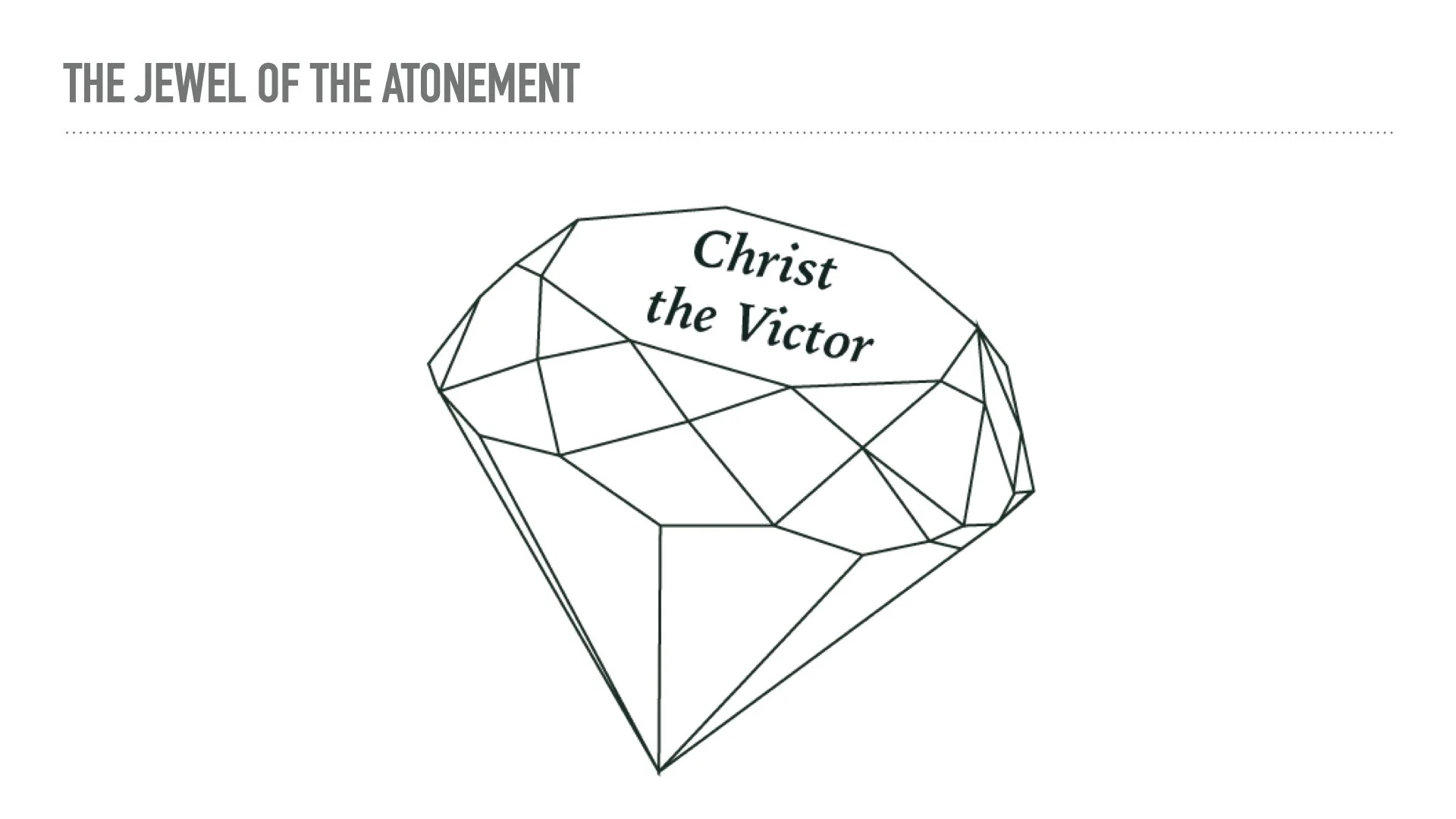
In the cap of the gem is “Christ the Victor.” Jesus’ atoning work brings victory over Satan, sin, and death. Jesus’ death brings this victory. Jesus rides into Jerusalem as the king who brings peace, and this peace is achieved through defeating the one who brought sin and death into this world.
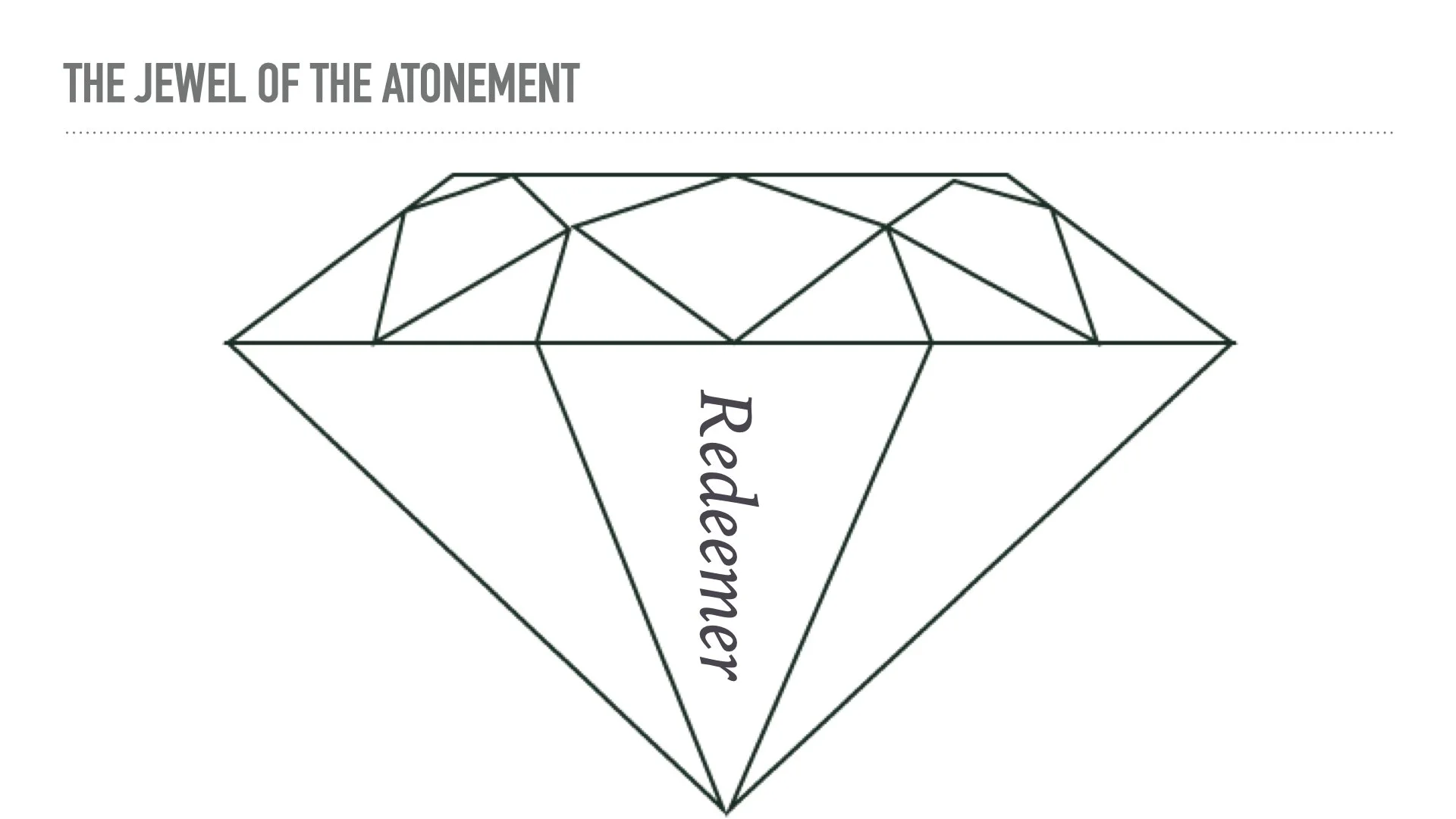
Then, underneath “Christ the Victor,” we have “Redeemer.” Jesus paid the price for our freedom from the slavery of sin. Today, we will answer:
What is the price that he paid?
The Price of Redemption | Propitiation
On the Cross Jesus paid the penalty for our rebellious sin. We tend to think of sins as mistakes or something that isn’t that big of a deal in the long run, but God sees it much differently. Sin is an offense to God—not the ‘I’m-offended-by-everything-snowflake-variety’, but in a deep, hurtful way that we cannot conceive. The closest comparison would be for a loving parent—who gave life to their child, raised their child with all the love and compassion they can muster—to hear their child curse their parent and deny the parent’s existence and love. The child rebels against everything the parent stands for, and then proceeds to destroy their own life in this rebellion. That is how God sees our sin.
Sin is an act of rebellion that brings our own death.
Sin is an act that conjures the wrath of God, because it is open rebellion against God. Sometimes when we hear the phrase “the wrath of God,” we picture something more like the pagan gods out to destroy humans out of pettiness. God’s wrath is less about God wanting to “get even,” as it is about God removing His presence and blessings.
Consider this: God is the ultimate and only source of goodness. “All good gifts come from Him” as James says. If the Source of goodness, peace, and love is removed from our lives, then what is left but evil, chaos, and hatred. Without a source of heat, there is only cold. If we continue to walk away from all forms of heat, we cannot be surprised if we freeze to death. If we continue to walk away from God, we cannot be surprised when we lose all good things—including life.
But just as the parent, though angry and right to be angry, does not want to see their child destroyed, neither does God want to see us destroyed, though He is perfectly just to allow it.
Let us look at what Scripture teaches us:
Since therefore the children share in flesh and blood, he himself likewise partook of the same things, that through death he might destroy the one who has the power of death, that is, the devil, and deliver all those who through fear of death were subject to lifelong slavery. For surely it is not angels that he helps, but he helps the offspring of Abraham. Therefore he had to be made like his brothers in every respect, so that he might become a merciful and faithful high priest in the service of God, to make propitiation for the sins of the people. For because he himself has suffered when tempted, he is able to help those who are being tempted.
Hebrews 2:14-18
We read this passage last week, and notice how Jesus’ Atonement is described. He destroys the work of the devil bringing deliverance to those subjected to lifelong slavery and fear of death. Hebrews uses language of the Old Testament sacrificial system to describe this work. It says Jesus was our “propitiation.” Propitiation is a theological word that simply means “substitute.” Under the Old Covenant, the animals would take the place of the people by dying in their place, but they could not take away sin completely. Human sin needs a human sacrifice. Even more, it would have to be a sinless human. The reason the animals had to be without blemish was to point to the need for an unblemished human. No human could fulfill this requirement until Christ came who lived a sinless life.
Hebrews picks up this line of reasoning in chapter 10.
After stating how it is impossible for the blood of bulls and goats to take away sins, Hebrews states,
And every priest stands daily at his service, offering repeatedly the same sacrifices, which can never take away sins. But when Christ had offered for all time a single sacrifice for sins, he sat down at the right hand of God, waiting from that time until his enemies should be made a footstool for his feet. For by a single offering he has perfected for all time those who are being sanctified.
Hebrews 10:11-14
Jesus’ single sacrifice accomplished what no amount of bulls or goats ever could. He was the perfect human having committed no sin. After his death, he sat down at the right hand of the God—again, imperial imagery denoting his place in the Kingdom of God as ruler and conqueror.
Jesus conquered death and sin through his substitutionary death on the cross and resurrection.
Now, as each new believer trusts in Christ, and as each new believer grows in their faith and holiness, that is one more “enemy” put under the feet of Christ. When Hebrews says, “waiting from that time until his enemies should be made a footstool,” it is a figure of speech that simply means “conquered.” We typically read this as the end of this age when Jesus returns and all the forces of evil, as well as unbelievers, are subjected to eternal judgement. While this end times view is certainly true, there is also the ongoing transformation in which God’s enemies are being reconciled to God through Christ.
We will talk more about reconciliation next week, but for this week, I would like to point out the process that is described in Hebrews 2:18 and Hebrews 10:14. Because Christ has suffered when tempted, he can help those being tempted (2:18), and also his single sacrifice perfects those who are being sanctified (10:14).
Christ’s finished work of propitiation empowers our ongoing process of growth and sanctification.
If we think of the Atonement as only Christ making a sacrifice for our sin, we will look at the Atonement as only a legal matter. And while that is one part, that is not the whole gemstone. That is why I go back to the gemstone illustration.
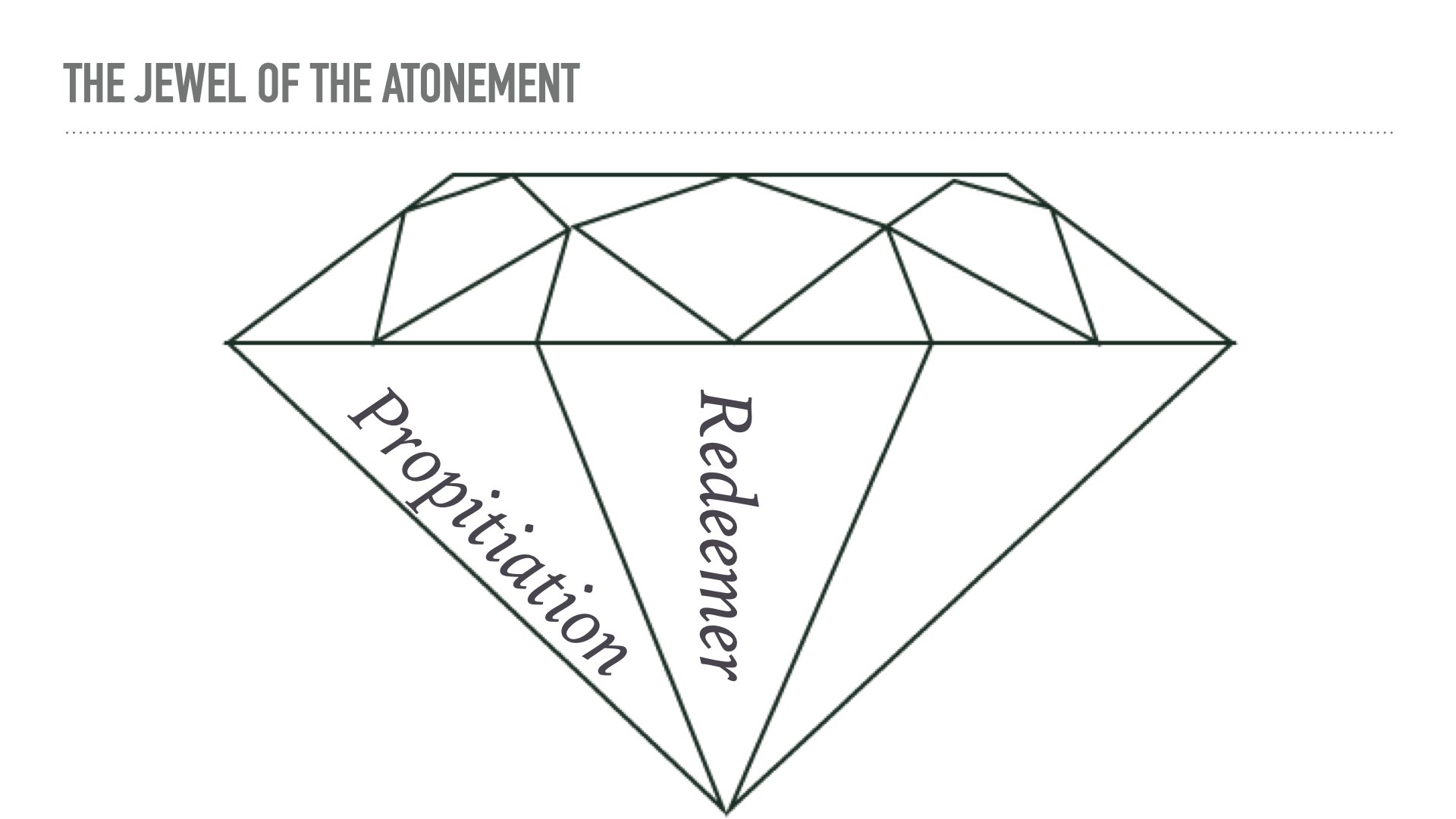
Christ is Victorious, and he is victorious by offering himself as payment for our redemption. But, as Hebrews 2:18 and 10:14 point us to, there is another way in which he brings victory.
The Effect of Redemption | Expiation
The next face on the gemstone is “expiation.”
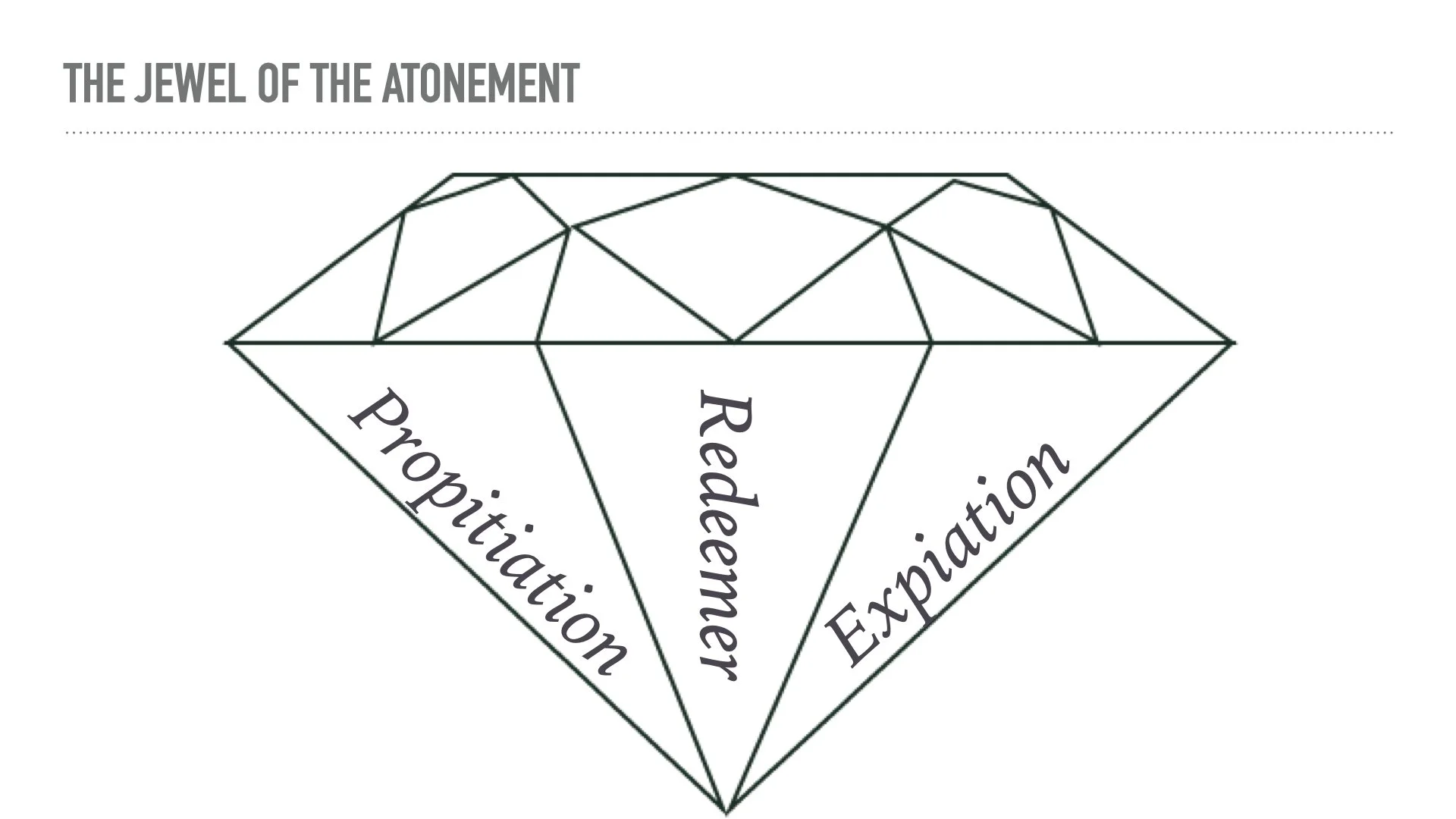
‘Expiation’ is a fancy theological word that deals with removing sin—think ‘expelling’ for ‘expiation.’ When we trust in Christ for salvation, His Atonement removes sin from our hearts and minds.
On the Cross Jesus provided the cure for our sinful corruption.
Here, again, Hebrews helps us understand how Jesus’ atoning work cleanses us from sin.
But when Christ appeared as a high priest of the good things that have come, then through the greater and more perfect tent (not made with hands, that is, not of this creation) he entered once for all into the holy places, not by means of the blood of goats and calves but by means of his own blood, thus securing an eternal redemption. For if the blood of goats and bulls, and the sprinkling of defiled persons with the ashes of a heifer, sanctify for the purification of the flesh, how much more will the blood of Christ, who through the eternal Spirit offered himself without blemish to God, purify our conscience from dead works to serve the living God.
Therefore he is the mediator of a new covenant, so that those who are called may receive the promised eternal inheritance, since a death has occurred that redeems them from the transgressions committed under the first covenant.
Hebrews 9:11-15
Verse 13 points us back to the Book of Numbers that we have been working through. Numbers 19 details a sacrificial offering of a heifer in which the ashes are used to create a purifying water. If this practice, as well as the other sacrifices, can purify the body, how much more will the blood of Christ, who offered himself without blemish to God, purify our consciences? We are able to move away from dead works serving the living God because Christ’s sacrifice is able to cleanse our hearts, minds, and souls from sin.
Where propitiation tends to look at the Atonement as a legal matter, Expiation leans towards looking at the Atonement as a medical matter. Sin is not just breaking the law. It is a corruption of the soul that infects the heart and mind, also. By trusting in Jesus for forgiveness of sin, we are also trusting that he will cleanse us from sin. They work hand in hand. Consider how John describes the union between our forgiveness and our cleansing.
But if we walk in the light, as he is in the light, we have fellowship with one another, and the blood of Jesus his Son cleanses us from all sin. If we say we have no sin, we deceive ourselves, and the truth is not in us. If we confess our sins, he is faithful and just to forgive us our sins and to cleanse us from all unrighteousness. If we say we have not sinned, we make him a liar, and his word is not in us.
1 John 1:7-10
The thrust of this passage from 1 John deals with the link between our faith and our behavior. Jesus came to defeat Satan and deal with our sin problem. If we do not recognize our need for a Savior, we are saying Jesus died for nothing. But, if we confess our sins, then He is faithful and just to forgive us and cleanse us, because Jesus has already accomplished the price and cure. And so, as we close for today, let’s consider how we can receive forgiveness and cleansing of sin.
We receive the cure for sin when we confess our sin.
Someone might ask, “Doesn’t God already know about our sin?” Yes, He does. Confession isn’t about telling God something He doesn’t know. It is about agreeing with God on the condition of your heart. In Recovery groups, you will often hear, “The first step to recovery is acknowledging you have a problem.” Everyone knows you have a problem. You know. Your friends know. God certainly knows. It’s not about revealing anything. It’s about acknowledging the reality of the situation and humbling yourself in order to receive help.
The fact is you know you have a sin problem. Your friends know. Your family knows. God certainly knows. The question is, “Are you willing to admit your problem in humility, so that you can receive help from the only One who can help you?”