
The High Holy Days | Numbers part 32
Scripture Reading: Hebrews 4:10-11
In our Scripture Reading today, Hebrews tells us to enter God’s rest—a Sabbath rest. And by entering His rest, we can avoid falling into disobedience. There is a paradox of faith in that it is not by working we can be obedient, but rather we must rest in God. We are called to walk with the Spirit, to train up for righteousness, to exercise spiritual discipline, and yet, obedience comes primarily through spiritual rest. Thus, the Lord declares,
Be still, and know that I am God.
I will be exalted among the nations,
I will be exalted in the earth!
Psalm 46:10
When Jesus told His disciples to follow Him, He said,
Come to me, all who labor and are heavy laden, and I will give you rest. Take my yoke upon you, and learn from me, for I am gentle and lowly in heart, and you will find rest for your souls. For my yoke is easy, and my burden is light.
Matthew 11:28-30
As we continue to look at the Sabbath offerings of Numbers 28 & 29, it can be easy to see these laws as “another command the people must do,” but Jesus reminds us these commands are not supposed to be burdensome. “The Sabbath was made for man.” These are times to remember, to reflect, and to rest in the glory of God.
The Sabbath festivals are times to reflect, rejoice, and rest in the Lord’s work among His people.
Passover Offerings | Numbers 28:16-25
“On the fourteenth day of the first month is the Lord's Passover, and on the fifteenth day of this month is a feast. Seven days shall unleavened bread be eaten. On the first day there shall be a holy convocation. You shall not do any ordinary work, but offer a food offering, a burnt offering to the Lord: two bulls from the herd, one ram, and seven male lambs a year old; see that they are without blemish; also their grain offering of fine flour mixed with oil; three tenths of an ephah shall you offer for a bull, and two tenths for a ram; a tenth shall you offer for each of the seven lambs; also one male goat for a sin offering, to make atonement for you. You shall offer these besides the burnt offering of the morning, which is for a regular burnt offering. In the same way you shall offer daily, for seven days, the food of a food offering, with a pleasing aroma to the Lord. It shall be offered besides the regular burnt offering and its drink offering. And on the seventh day you shall have a holy convocation. You shall not do any ordinary work.
Numbers 28:16-25
As we get into the annual Sabbaths, it will help us to understand the difference between the ancient Jewish calendar and our modern Gregorian Calendar.
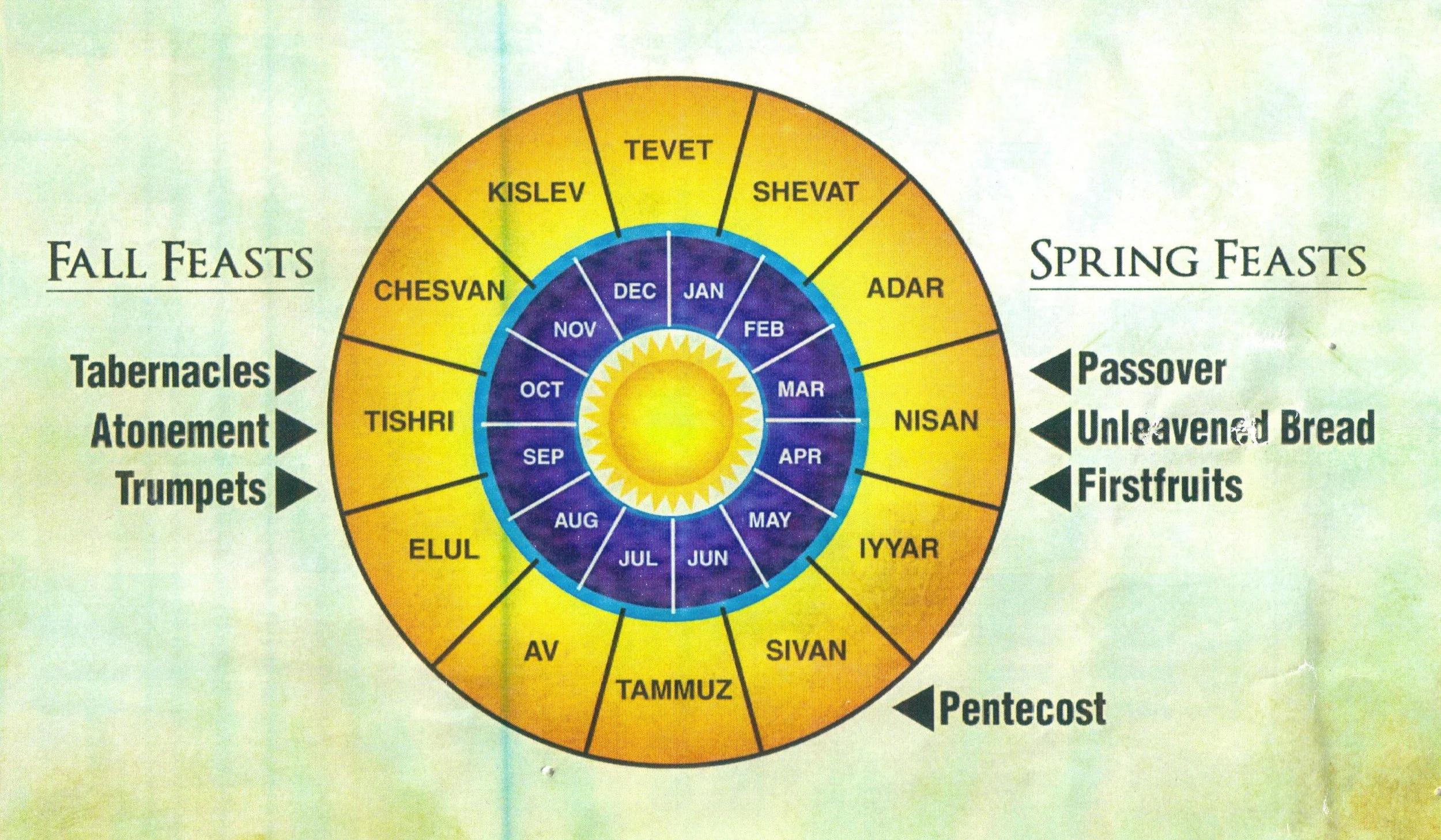
The “start” of the Jewish calendar does not fall in the same month as the modern Gregorian. Spring is the beginning of the new year.
First, notice the Jewish New Year is in March. The exact date moves around the Gregorian Calendar because it has to do with when the New Moon occurs. This movement also explains why all the Jewish holidays shift around each year (and why Easter shifts around). Fun fact: because each month is either 29 or 30 days, it creates a leap year in the calendar periodically which is Adar II, or Adar gets extended for a number of days. The principle is the current year does not end until the new one begins.
With that said, Passover is the 14th day of the first month, or the 14th day after Spring starts. It is a “holy convocation.” No ordinary work is to be performed, and there are additional sacrifices to be made in preparation for the day, as well as the male goat for atonement.
Holy Days are to be treated as special days on the calendar in which ordinary work ceases for special celebrations.
In this case, Passover is about the Passover event in Exodus. God’s people are to remember their freedom from Egypt that came when the Lord brought them out. You may recall the people were in bondage for 400 years because the new pharaohs did not know Joseph, nor did they remember what the God of the Hebrews had done for Egypt. Using Moses and Aaron as spokesmen, God did battle with the gods of Egypt bringing freedom to Israel.
At the climax of the story, the Lord sends a death angel to collect the first born of every family. Only if the family had sacrificed a lamb and painted their doors with the blood of the lamb as prescribed, did the death angel pass over the household.
When Israel left Egypt in that first spring, the Lord told Moses, this is the new year for them. The beginning of Israel as a nation would begin on that day. Two weeks into the new year, they were to celebrate the Passover event through this Sabbath festival. Then, they would continue to remember it each year.
Though Christians are not all in the habit of celebrating Passover, we do have another holiday in which God brought us freedom from bondage. We commemorate the day Jesus overcame sin and death through His Resurrection. We call it Easter.
When we think about Easter, do we keep it holy? Is it a holy convocation for us? What is our sacrifice of praise that we bring on that day?
Annually, I hear discussions of what we should or shouldn’t do on Easter, and some of that is helpful. But, whether you agree with eggs and chocolate or not, I want to throw out something else to chew on. What about Good Friday? Do we treat it as a holy convocation?
I believe we have lost something in our low church culture. Because we do not hold to the liturgical calendar as other denominations, we don’t have the same attention to the days leading up to Easter. If we aren’t careful, Easter becomes just another Sunday—only with more colors and candy. I believe by including Good Friday in our celebrations, it helps us prepare spiritually for Easter. There are no bunnies, no candy-filled eggs, no chocolates, and no other frills with Good Friday. It is a simple and solemn time to remember the sacrifice our Lord made on the cross for us.
There is an added sacrifice of time and praise necessary for Passover and Easter because the days are to celebrate God’s salvation.
Feast of Weeks Offerings | Numbers 28:26-31
“On the day of the firstfruits, when you offer a grain offering of new grain to the Lord at your Feast of Weeks, you shall have a holy convocation. You shall not do any ordinary work, but offer a burnt offering, with a pleasing aroma to the Lord: two bulls from the herd, one ram, seven male lambs a year old; also their grain offering of fine flour mixed with oil, three tenths of an ephah for each bull, two tenths for one ram, a tenth for each of the seven lambs; with one male goat, to make atonement for you. Besides the regular burnt offering and its grain offering, you shall offer them and their drink offering. See that they are without blemish.
Numbers 28:26-31
The Feast of Weeks, or Shavuot, commemorates the giving of the Torah on Mt. Sinai, as well as an agricultural festival celebrating the wheat harvest. Again, no ordinary work is to be done. It is a holy convocation.
It is absolutely worth noting the link between God giving the Torah and the harvesting of wheat.
And he humbled you and let you hunger and fed you with manna, which you did not know, nor did your fathers know, that he might make you know that man does not live by bread alone, but man lives by every word that comes from the mouth of the LORD.
Deuteronomy 8:3
The Israelites were to remember the manna when they ate the bread from the wheat harvest. They were also to remember the Torah as the spiritual food needed for their souls.
Fast forward to the Resurrection of Jesus Christ. 50 days after Resurrection Sunday, the Sunday following Passover, it is time for Shavuot once again. But this time, it is not the Torah that God gives the disciples. The Holy Spirit descends on them like tongues of fire.
Each year, as we remember Pentecost, we are reminded once again “Man does not live on bread alone, but by every word that comes from the mouth of the Lord.” And that word that comes out is given to us by the Holy Spirit.
The Feast of Weeks, Pentecost, commemorates God’s provision of life and growth throughout the year.
Feast of Trumpets | Numbers 29:1-6
On the first day of the seventh month you shall have a holy convocation. You shall not do any ordinary work. It is a day for you to blow the trumpets, and you shall offer a burnt offering, for a pleasing aroma to the LORD: one bull from the herd, one ram, seven male lambs a year old without blemish; also their grain offering of fine flour mixed with oil, three tenths of an ephah for the bull, two tenths for the ram, and one tenth for each of the seven lambs; with one male goat for a sin offering, to make atonement for you; besides the burnt offering of the new moon, and its grain offering, and the regular burnt offering and its grain offering, and their drink offering, according to the rule for them, for a pleasing aroma, a food offering to the LORD.
Numbers 29:1-6
The Feast of Trumpets is also called Rosh Hashanah, or the Jewish New Year. You may ask, “I thought Passover was at the New Year?” Yes, it is. There are actually 4 new years in the Jewish calendar, so it may be better to call them “seasons,” but nevertheless, they each have a significance. For Passover, it begins the ecclesiastical year and the cycle of festivals. For Rosh Hashanah, it is the beginning of the civil calendar and marks the beginning of tithing for the year. It is somewhat similar to our “calendar year” vs “fiscal year”.
It occurs in the seventh month which is roughly equivalent to our October. It is a harvest festival.
The Feast of Trumpets commemorates the harvest of the year and a renewal of the covenant with the Lord.
Now, as Christians we do not have an equivalent holiday, but perhaps we should. Some Christians have attempted to convert Halloween into a Harvest Festival, though with varied success. There is also a more recent push for us to observe it as “Reformation Day” since it was October 31, 1517 that Martin Luther nailed his 95 theses to the church door of Wittenberg. This date is considered the start of the Reformation.
But I think it may be more helpful to look to the future for a Christian Rosh Hashanah. There are some who speculate Jesus will return during the Feast of Trumpets. They point to Revelation in which it is said the trumpet will sound and God will send His angels to collect His people. While I think it is absolutely foolish to attempt to put a day on Christ’s Return, I do believe we should have in our calendar a special day to reflect on the salvation that came in Jesus and the salvation that is coming when Christ Returns. In the past, Christmas was such a day. The first celebrants of Christmas looked not just to the Incarnation, but also to Christ’s Return. Just as Jesus came the first time, He has promised to return.
As Christians, we can look at the Feast of Trumpets and remember God’s New Covenant to make all things new at the consummation of this age.
Day of Atonement | Numbers 29:7-11
“On the tenth day of this seventh month you shall have a holy convocation and afflict yourselves. You shall do no work, but you shall offer a burnt offering to the LORD, a pleasing aroma: one bull from the herd, one ram, seven male lambs a year old: see that they are without blemish. And their grain offering shall be of fine flour mixed with oil, three tenths of an ephah for the bull, two tenths for the one ram, a tenth for each of the seven lambs: also one male goat for a sin offering, besides the sin offering of atonement, and the regular burnt offering and its grain offering, and their drink offerings.
Numbers 29:7-11
In this prescription for Yom Kippur, Numbers leaves out much of what is to occur for the holiday. Again, this section is focused on the amount of offerings for each animal. This Sabbath is a follow up to Rosh Hashanah. At the Feast of Trumpets, the people celebrate and commemorate the new year of harvest. On Yom Kippur, they “afflict themselves” meaning they fast. It is not a day of celebration, but rather a day in which reverence is key.
The sins of the people will be placed on the scapegoat and sent away from the camp. The lamb that passes the test to be without blemish—the lamb above all the other lambs—will be sacrificed on the altar. And, it is the one day of the year in which the High Priest may enter the Holy of Holies.
Also, in preparation for the High Priest to enter, everything had to be consecrated. Every piece of the tabernacle was cleansed from the inside out. The High Priest would sanctify himself at the altar, then the blood was used on the ark of the covenant. Next, the sacrifices’ blood was used on the incense and the burnt offerings. The sin of the priests and people was essentially swept out the front door with the sacrifices.
The Day of Atonement was the annual reset and cleansing of sin for the tabernacle and people.
It would do us good as God’s people to have such a Holy Day. Perhaps it is Easter. For me, I tend to see Easter in this way. It is an annual revival in my heart as we remember the Day our sins were forgiven. But, if we do not take the time to sanctify ourselves, to look inward and recognize the sin that still holds on to us, it does us no good in our growth.
Feast of Booths | Numbers 29:12-40
On the fifteenth day of the seventh month you shall have a holy convocation. You shall not do any ordinary work, and you shall keep a feast to the LORD seven days. And you shall offer a burnt offering, a food offering, with a pleasing aroma to the LORD, thirteen bulls from the herd, two rams, fourteen male lambs a year old; they shall be without blemish; and their grain offering of fine flour mixed with oil, three tenths of an ephah for each of the thirteen bulls, two tenths for each of the two rams, and a tenth for each of the fourteen lambs; also one male goat for a sin offering, besides the regular burnt offering, its grain offering and its drink offering.
…
These you shall offer to the LORD at your appointed feasts, in addition to your vow offerings and your freewill offerings, for your burnt offerings, and for your grain offerings, and for your drink offerings, and for your peace offerings.”
So Moses told the people of Israel everything just as the LORD had commanded Moses.
Numbers 29:12-16 & 39-40
On this last Feast Day in Numbers, the people remember their wilderness wandering. Just as they had to live in temporary homes for 40 years, now they will live in a temporary booths called a Sukkot, thus the name of the festival, Sukkot. The festival will take 8 days, and for each day, there is a number of animals that must be sacrificed. The 8 days come at the very end of the harvest season, and so the people remember each harvest when their ancestors could not harvest because they were nomads wandering for their sin.
This particular festival is considered one of the more joyous ones. Families tend to gather in each other’s booths and celebrate. The harvest is complete, the year’s work is done, and the people can enjoy the fruit of God’s provisions. It is something relatively akin to our modern Thanksgiving.
Sukkot, much like Thanksgiving, is a time to celebrate God’s blessings on the year’s labor.
Now, at the end of the chapter, Moses makes note that he has commanded the people “just as the LORD has commanded.” These festivals are given to the people from the Lord so that they can remember the work of the Lord throughout the year. Let’s review them before we close.
Passover - Pesach - the Lord delivers Israel out of Egypt
Feast of Weeks - Shavuot (Pentecost in Greek) - The Lord gives His Word
Feast of Trumpets - Rosh Hashanah - The Lord ushers a new year
Day of Atonement - Yom Kippur - The Lord cleanses His people
Feast of Booths - Sukkot - The Lord gives His People a new dwelling place
When we began Numbers, I mentioned the Four Senses of Scripture in which we move from the literal basic meaning to the higher meaning of how the Scriptures point us to Christ and His Kingdom. Notice the thematic development of these festivals and how they correspond to the Gospel.
Christ held his Last Supper during the week of Passover. The Lord’s Supper we partake each month is a version of the Passover Meal. Christ delivers His people out of the bondage of slavery during Passover.
After Christ ascended, He told his disciples to wait in Jerusalem for the coming Helper, the Holy Spirit. The same Spirit that hovered over the waters at Creation, the same Spirit Who empowered the Messiah to do the work of Atonement, was given at Pentecost, the Feast of Weeks.
Christ promised to return at the sound of an angel’s trumpet blast. Though we wait for this new age to come, we know we are already in a new era. The Old Covenant was fulfilled, and now we wait in this New Covenant with Christ. We live in a new Rosh Hashanah, but one day there will be yet another. On that day, we will enter a period of time much like the time between Rosh Hashanah and Yom Kippur.
Revelation tells us there is a process of re-creation in which Jesus returns to rid the world of sin, Satan, and even death. Though we are actively being cleansed now, there will be a day when that cleansing is completed for all of Creation.
And when that time is done, we will enter a new Sukkot. We will no longer be wanderers in this temporary home we call ‘Earth’. We will receive the New Heaven and New Earth in which the promise for God’s people to inhabit the Promised Land forever will be ultimately fulfilled.
We have these annual reminders because our whole year is to tell the story of Jesus and His Gospel.
When we allow these holy days to be “just another day,” we lose sight of why these Sabbath days exist. They are not laws that must be done. They are reminders that we can enter God’s rest. And in following these days of rest, we will find ourselves more obedient because we will have spent time with the Lord who makes all things new.
But they also remind us that not everyone will join in God’s rest. Passover only worked for those who put the lamb’s blood on their door posts. Yom Kippur only atoned for the sins of those within the nation of Israel. Only God’s people who were obedient in their wilderness wandering received their new place in the Promised Land. Likewise, only those who surrender to Jesus Christ for forgiveness and eternal life will have an inheritance in the Kingdom of God.