
The Habit of Prayer | Churchy Habits part 4
Scripture Reading: Psalm 51
This week we continue our series on the habits of the Christian life. We have been looking at how Christians should organize their lives based on Ephesians 5:
Look carefully then how you walk, not as unwise but as wise, making the best use of the time, because the days are evil. Therefore do not be foolish, but understand what the will of the Lord is.
Ephesians 5:15-17
We first looked at being intentional about how we spend our time—especially taking note of the Great Commandments to Love God and Love People. We are to be intentional in being in the presence of the Lord daily. We then saw how loving others requires the same kind of intentional effort. Last week, we examined a method of reading Scripture that incorporates meditation on the Word. This week, I would like us to focus on that last bit of verse 17 which calls us to understand what the will of the Lord is. Now, we certainly can understand that more and more as we read and meditate on God’s Word, but this week, I would like to look at the other part of that daily Sabbath we discussed—prayer.
To help, I’d like to take us on a little detour.
A Brief Introduction to Neurotheology
There is an emerging field of neuroscience called “neurotheology.” It is pioneered by Dr. Andrew Newberg who wanted to scientifically observe how religious practices affect the brain. He studied Catholic nuns and Buddhist monks, because they have different forms of meditation. He was able to map which parts of the brain lit up using what’s called a SPECT scan. It tracks the blood flow in real-time marking which parts of the brain light up. He would later apply the same method to Sikh chanting and people speaking in tongues.
Now, some of what was found makes perfect sense. Meditative practice based on verbal prayers lit up language centers. Visual meditations kept the language centers quiet, but the visual cortex lit up. But there are two takeaways that are worth noting for today:
When an atheist was asked to contemplate the idea of God (since they would not believe in the possibility of communing with Him), their brain treated God as a logic puzzle rather than any sort of relationship. The ritual of meditation itself, without a sense of faith, did not bring about any sort of change in the brain.
The area of the brain associated with a person’s sense of self or individualism quieted during the meditations. Various religious traditions might describe the sensation differently, but basically, when the person reached a meditative state, they felt more one with the Divine and less bound to this physical world. This experience inevitably brought up more feelings (and habits) of altruism and empathy.
Now, in connection with Dr. Newberg’s work is the work of Dr. J. P. Moreland and Dr. Lee Warren. As far as I know, these three doctors have not worked together, but their separate works build a fascinating picture. Dr. Moreland is a Distinguished Professor of philosophy at Talbot School of Theology, and Dr. Warren is a practicing neurosurgeon in North Platte—yes, the North Platte 45 minutes up the road. But these doctors in the respective fields build a picture of what Neurotheolgy is discovering—or perhaps re-discovering.
Not only does the soul exist, but we can map its interaction with the mind and body. Human beings have a consciousness that is not bound to the gooey mass called your brain. Yes, your brain affects how you think, but your thinking can also affect the brain. They seem to be independent entities that work in relationship very similarly to how your brain affects your body movements, and your body movements affect your brain—and apparently, your soul, as well.
And so, to sum up this little rabbit hole, I want to connect this whole field of research to the truth about the habit of prayer. 21st century neuroscience is confirming what the Bible told us 2000 years ago. We are not bound to continue life as we always have. Perhaps our bodies do not operate as they should, or we have urges that pull us in a direction we don’t want to go. Perhaps our minds keep bringing up thoughts we don’t like or rehash troublesome emotions. Perhaps when we perceive who we really are, we don’t like what we see. None of these things are set in stone. We really can change. We just need help beyond ourselves. That help is Jesus.
God has given us the power to alter the trajectory of our lives through Christ Jesus.
Words Matter or Fun with Biblical Languages | Acts 3:17-21
There are two words the Bible uses to describe this process of finding help in Christ, and those are metanoia and epistretho. There is a Hebrew equivalent for both of these words, shûb. These words are typically translated as “repent” or “turn away.” Now, these English words are so common in church vernacular, I am afraid we may not realize what we’re saying. We just know the words. As we look at what creating a habit of prayer entails, it will help us to dig into these words a bit more. To help, let’s take a look at Acts 3.
This chapter is Peter’s famous sermon at Pentecost. The Holy Spirit has just descended on the apostles in the upper room. They have gone outside and preached to the masses gathered in Jerusalem for the festival of Pentecost. Each person has heard the Gospel—the Kingdom of God is available to those who trust in Jesus Christ—in their own language. One speaker, speaking one language, is understood by others in another language. It is a miraculous work of God. The problem for many, though, is they are hearing the foreign languages as foreign language. To onlookers not actively hearing the Gospel, the disciples all sound drunk. Peter addresses the whole crowd and begins by saying, “These guys aren’t drunk. It’s too early in the day for that. Let me tell you what is happening.” He then tells the story of Jesus beginning with God’s promises all the way to the climax where he points out many of the people there in the crowd were the same ones who put the Promised Messiah on the cross. He then calls them to repent in verse 17:
“And now, brothers, I know that you acted in ignorance, as did also your rulers. But what God foretold by the mouth of all the prophets, that his Christ would suffer, he thus fulfilled. Repent therefore, and turn back, that your sins may be blotted out, that times of refreshing may come from the presence of the Lord, and that he may send the Christ appointed for you, Jesus, whom heaven must receive until the time for restoring all the things about which God spoke by the mouth of his holy prophets long ago.
Acts 3:17-21
Peter tells them to repent and turn back. When we typically define “repent,” it is usually something like “turn around” or “change your mind.” These are helpful definitions, but metanoia means a bit more.
Repentance is a reorientation of the mind and heart toward God.
Peter is telling the crowd they need to rethink their ideas about God, their idea of who Jesus is, and where they stand before the God they supposedly serve. After they rethink on these things, they are then to turn back to God—shûb or epistretho. The Old Testament is filled with calls for God’s people to turn back to God. Here, Peter restates this call, but begins by telling them they need to rethink everything. The thought patterns that brought them to the state of yelling “Crucify him!” will do them no good. Those thought patterns need to go.
Before we go any further, something jumped out as I studied this passage. Notice what Peter says in verses 17 & 18. God had promised His Messiah would suffer. The Messiah had to suffer in order to pay the penalty of sin. Was the crowd guilty of killing Jesus? Yes. Did God know they would do this? Yes. But, did they know they were killing the Messiah? No. They acted in ignorance.
Peter doesn’t condemn the crowd. He acknowledges their ignorance and calls them to repent now that they know better. The crowd is not bound to continue in their wickedness and ignorance. Peter has given them new information and a new path. They now have the choice to either continue in their sinful state, or they can change. They can have “times of refreshing” because they can be in the presence of the Lord through Jesus.
Christianity has never been about modifying behavior or “doing the right thing.” It is about God coming to us, even in our ignorance of His very existence or the ignorance of our hatred of Him, so that we can know Him as He truly is. And when we know Him better, we will love Him better. The crowd that cried out for Jesus’ crucifixion is now called to love this same Jesus, because the God they hated took their sin upon Himself so they can be saved and loved.
For my visual people, consider this diagram.
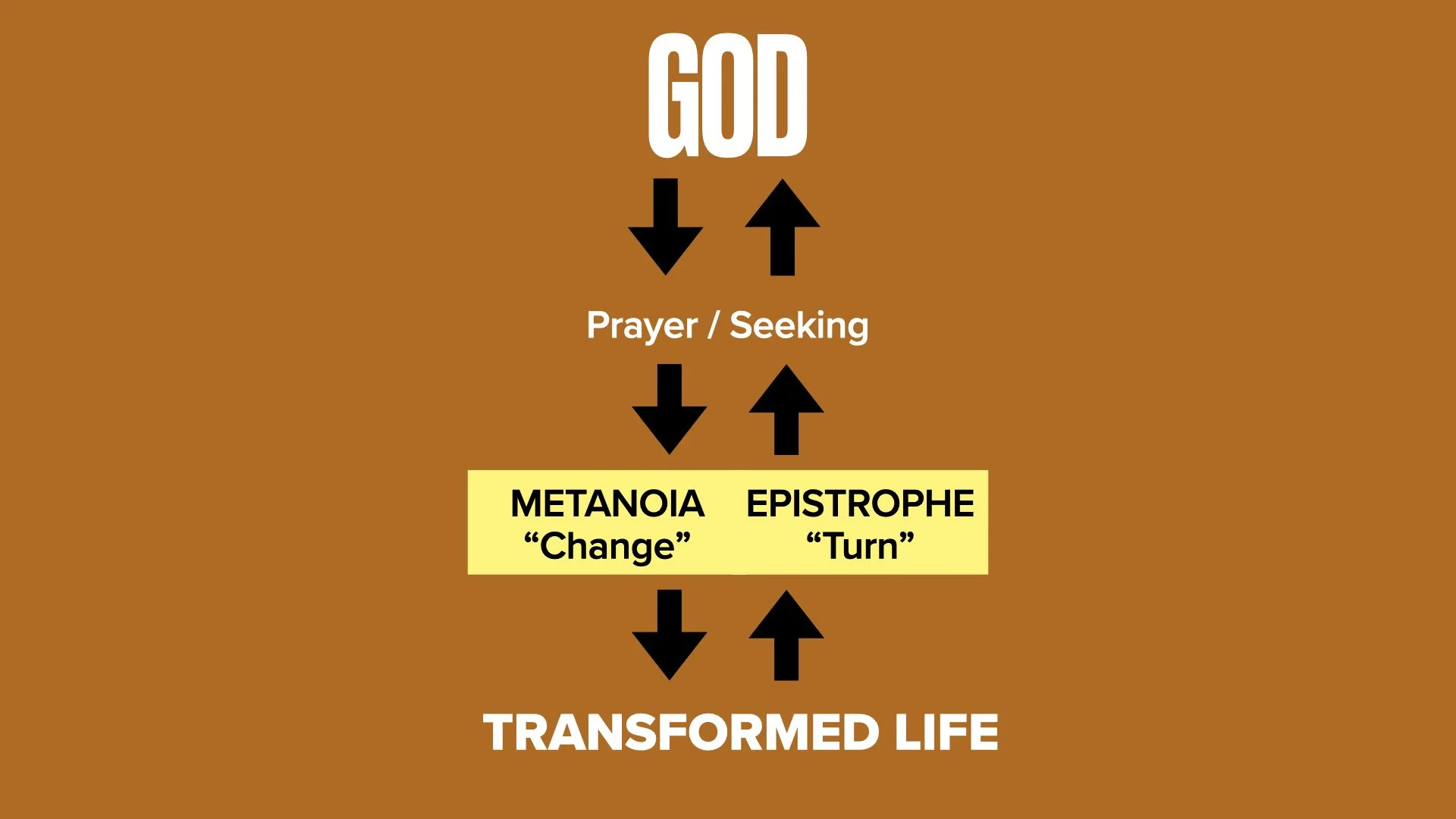
God began the dialogue 2000 years ago when He sent us Jesus. Now, because of the cross and resurrection, God invites us to commune with Him. But that communion can’t happen unless we change our thinking and turn our minds to Him. God seeks us, calls us to reorient our minds so that we can hear from Him, and when we do that, when we surrender to the Lord Jesus, we can seek the true God.
That’s how the conversation with God starts.
There are observable benefits to prayer for the individual. And yet, the greatest benefit for the individual is that they recognize the Universe is not all about them. Paradoxically, if we truly want to start helping ourselves, we have to stop thinking so much about ourselves. We have to reorient our life around Jesus—or as the prophets and Peter said, “turn back.”
Prayer is the practice of reorienting our minds and hearts on the Lord.
So, how do we begin the habit of prayer? This same Jesus gave us a template to help us out.
Learning to Pray from Jesus | Matthew 6:7-13
One day, the disciples asked Jesus to teach them to pray. Matthew records this teaching as part of the Sermon on the Mount. Given how often Jesus had to repeat himself, it makes sense the teaching pops up in multiple places. In either case, here is how Jesus said to pray:
“And when you pray, do not heap up empty phrases as the Gentiles do, for they think that they will be heard for their many words. Do not be like them, for your Father knows what you need before you ask him. Pray then like this:
“Our Father in heaven,
hallowed be your name.
Your kingdom come,
your will be done,
on earth as it is in heaven.
Give us this day our daily bread,
and forgive us our debts,
as we also have forgiven our debtors.
And lead us not into temptation,
but deliver us from evil.
Matthew 6:7-13
There is a pattern in this prayer that follows the pattern of turning back that we have looked at. First, notice Jesus says to avoid empty phrases and many words. God knows what you need. He’s already paying attention. There’s no need to pray like pagans who mindlessly repeat themselves or attempt to cajole their gods. Remember when I mentioned different forms of prayer light up different parts of the brain? It’s possible to condition our brains to the wrong type of prayers. Jesus reminds us in verse 7 to think about how we are going to pray.
Godly prayers have intention and purpose behind them.
To that point, let’s take a look at the pattern of prayer Jesus gives us.
The prayer begins with “Our Father in heaven, hallowed be your name.” Of course, God knows exactly who He is. The point is to direct our minds on who we are addressing. Remember the first part of the Great Commandment is to know the true God. As we sit, stand, or bow to pray, we recognize who we are addressing.
Acknowledge Who God is and to whom you are addressing your prayer.
We begin with “Who is God?” Maybe you are struggling with knowing exactly who God is. That’s ok, too. Just begin with what you know. How has God revealed Himself? It’s ok if you sound a little childish when you first get started. Jesus said the kingdom of heaven belongs to those who humble themselves like a child, so it’s better to start off a little childish than to not pray at all.
Submit your will to God’s will.
Jesus says, “Your kingdom come. Your will be done—on earth as it is in heaven.” Prayer is not about what you want. Yes, you can take your cares and your worries to Him, but you don’t start there. That’s still focusing on yourself.
In fact, psychologists are starting to change their own counseling practices in recent years. It used to be they wanted you to rehash every bad thing that ever happened to you, because the belief was that by identifying our sources of pain, we would be able to move past it. Now, many clinicians have noticed when patients continually return to past traumas, their brains think they are still in that traumatic moment. Their bodies start reacting as though the trauma is happening again. Counselors will no longer have the patient go through the moment again. They don’t advocate denial. That’s certainly not good, but they do have the patient say out loud “But now, things are different.” Dr. Warren mentions this in his material. When we remember those past traumas and triggers, if we remind ourselves who we are now is not who we were then, it helps our brain to calm down with all the trauma hormones and start firing those calming ones. That, in turn, affects our emotions, and we are able to start thinking more clearly about things.
And so, in our prayers, when we turn our attention and focus on God’s will and what God says, it reminds us (and our brains and body) that we are new creations in Christ. The old is gone. I love how John describes it in his first letter.
Little children, let us not love in word or talk but in deed and in truth.
By this we shall know that we are of the truth and reassure our heart before him; for whenever our heart condemns us, God is greater than our heart, and he knows everything. Beloved, if our heart does not condemn us, we have confidence before God;
1 John 3:18-21
When those doubts and past sins start creep up in our minds to condemn us, we remember that God is greater than our hearts, and “he knows everything.” God knows your doubts. God knows your past. And, God knows where you stand with Him. When we love in deed and in truth, we will know we are of the truth (i.e. we are God’s children), and that truth will reassure our hearts. Remind your brain of the reality of Christ. And this leads us to the next point.
Recognize your needs for daily living.
Jesus uses the term “daily bread” to remind us of two things. First, we really can only concern ourselves with today. The past is gone—not much you can do about that. The future isn’t here yet. Plus, you aren’t even promised tomorrow on earth will come for you. Concern yourself with the current day’s tasks by asking God to help you with today. Second, it is absolutely an allusion to the manna in the wilderness story from Numbers. As the Israelites wandered through the desert, they asked God for food. God delivered with daily provisions of manna—a type of seed that could be made into bread.
Likewise, Jesus fed thousands of people with a few loaves after declaring himself the Bread of Heaven. We need God each day. “His mercies are new each day,” as Lamentations reminds us. You are not bugging Him when you go to Him each day. He wants us to go to Him each day!
Admit your continued need for God’s grace.
Jesus turns our attention on sin—both our own and others to us. We are called to forgive because Christ has forgiven us. We need God’s grace for both our sin and for our ability to forgive others their sin. And it is a constant need because humans constantly seem to find new ways to sin.
Confession really is good for the soul. It helps us focus on the reality of God’s grace, the reality of our situation, and the reality of God’s purpose and will for our life. Sin will hinder our prayers. Confess them and be cleansed.
Ask for God to show you the next step for whatever you are facing.
At the end, Jesus points us to the path we are walking. We seek God to keep us away from temptation and deliver us from evil. We looked at meditating on God’s Word last week as a way of walking in wisdom. In our prayers, are we asking God to guide our steps? Are there things that we just need to do differently so that we aren’t tempted in the first place? Ask God to show you these things.
Before we close, I want to give you one last Scripture. You see, I am convinced one of the reasons we fail to pray well is because of those last three steps. We don’t mind the part about praising God. We certainly don’t mind the part about casting our cares on Him. We usually don’t mind the asking for stuff part, either. What we do struggle with is the part about dealing with our fears and failures. This part of prayer reminds us of our weaknesses. Let me read for you what one of the great heroes of the faith had to say about this.
So to keep me from becoming conceited because of the surpassing greatness of the revelations, a thorn was given me in the flesh, a messenger of Satan to harass me, to keep me from becoming conceited. Three times I pleaded with the Lord about this, that it should leave me. But he said to me, “My grace is sufficient for you, for my power is made perfect in weakness.” Therefore I will boast all the more gladly of my weaknesses, so that the power of Christ may rest upon me. For the sake of Christ, then, I am content with weaknesses, insults, hardships, persecutions, and calamities. For when I am weak, then I am strong.
2 Corinthians 12:7-10
Paul noticed something about his walk and ministry. It was highly successful. His faithfulness brought about revelations, new churches, and thousands of new Christians. He is regarded as the greatest missionary for a reason. But, he also noticed a thorn in the flesh was given to him, a messenger of Satan to harass him. Three times Paul asks God to remove this thorn. We don’t know what it is exactly. I have a theory, and I’m not alone in this, the thorn was some type of sin. Others think it was a sickness of sorts. Either way, it was something to do with his body. It’s in his flesh.
Perhaps your weakness is in your body. Age, sickness, infirmity, or some other ailment is wrecking your ability to serve well, and that is hindering your prayer life.
Perhaps your weakness is in your head. Depression, anxiety, self-image, or some other mental health issue is wrecking your ability to take control of your thoughts. This may even be leading to some habits that you wish you could kick, but here you are.
Perhaps your weakness is some version of both.
Regardless, you have tried asking God to remove this weakness time after time, but He doesn’t seem to be listening. He is listening. He just wants us to remember:
“My grace is sufficient for you, for my power is made perfect in weakness.”
There is power in God’s presence. There is peace in God’s presence. There is purpose in God’s presence.
And we enter God’s presence through prayer.