
Advent 2 | Brokenness and Restoration
Last week, we began our Advent Season with a look at the serpent’s deception and his crafty speech that led Adam and Eve to take from the forbidden fruit. This act of sin introduces a corruption into the world that continues today. But, we also saw this curse is actively being rolled back by Jesus who came to break the power of sin’s curse on humanity.
This week, we continue Advent with the theme of Love. The whole Christmas story is bound together with God’s love. He demonstrates His love for His broken humans by sending His Son to us. We will begin today, once again, in the Garden to see the downfall and consequences of their rebellion, and then head to Luke’s Gospel in which we read Mary’s response to God’s love in her own life.
Hearts Broken | Genesis 3:6-13
As way of review, in the first five verses the serpent tempts Eve to eat from the forbidden tree by offering a life outside of God’s control, and even more tempting, to become like God by knowing things that only God knows. Then, in verse 6 she takes the fruit. Take a look with me at the consequences of her (and her husband’s) actions.
So when the woman saw that the tree was good for food, and that it was a delight to the eyes, and that the tree was to be desired to make one wise, she took of its fruit and ate, and she also gave some to her husband who was with her, and he ate. Then the eyes of both were opened, and they knew that they were naked. And they sewed fig leaves together and made themselves loincloths.
And they heard the sound of the Lord God walking in the garden in the cool of the day, and the man and his wife hid themselves from the presence of the Lord God among the trees of the garden. But the Lord God called to the man and said to him, “Where are you?” And he said, “I heard the sound of you in the garden, and I was afraid, because I was naked, and I hid myself.” He said, “Who told you that you were naked? Have you eaten of the tree of which I commanded you not to eat?” The man said, “The woman whom you gave to be with me, she gave me fruit of the tree, and I ate.” Then the Lord God said to the woman, “What is this that you have done?” The woman said, “The serpent deceived me, and I ate.”
Genesis 3:6-13
First, as we looked at last week, their eyes are opened. But rather than seeing something wonderful, they recognize they are naked and become ashamed. Their shame is demonstrated in two ways, 1) they sew fig leaves together to make clothes for themselves and 2) when they hear the Lord walking, they hide.
The significance of these lines is purposeful. In Genesis 2:25, after the Lord creates Eve from Adam’s rib, the story explicitly states, “And the man and his wife were both naked and were not ashamed.” Their relationship is so harmonious, they have no need of even covering themselves. Now, because of their sin against God, they have also broken their relationship with one another.
We tend to think of sin as an individual act. If we sin against God, we have really only hurt ourselves. The Bible never treats sin with such individualism.
Sin always is against God, but it also always hurts others.
Trust is broken. Lives are torn apart—or ended. Society does not operate as it should because of sin. Eating the fruit would seem like it should only affect their relationship with God, and yet, we see they are ashamed of each other also. In case we miss this point, the conversation with God expounds the problem even further. God directs His questioning to Adam asking what has he done, and immediately, Adam blames Eve—and God by connection. “It’s the woman’s fault that you gave me.” Sin has clouded Adam’s mind into believing that somehow God is at fault for his failure. Eve has a similar response passing the blame onto the serpent. Neither human is willing to accept their part of the rebellion.
But, as we looked at last week, there is still hope. There will be One from the line of Eve that will crush the serpent’s head and end his work. Ironically, or perhaps providentially, one consequence of Eve’s sin is multiplication of pain in childbearing, and yet, it will be a baby born in her family that will end this curse.
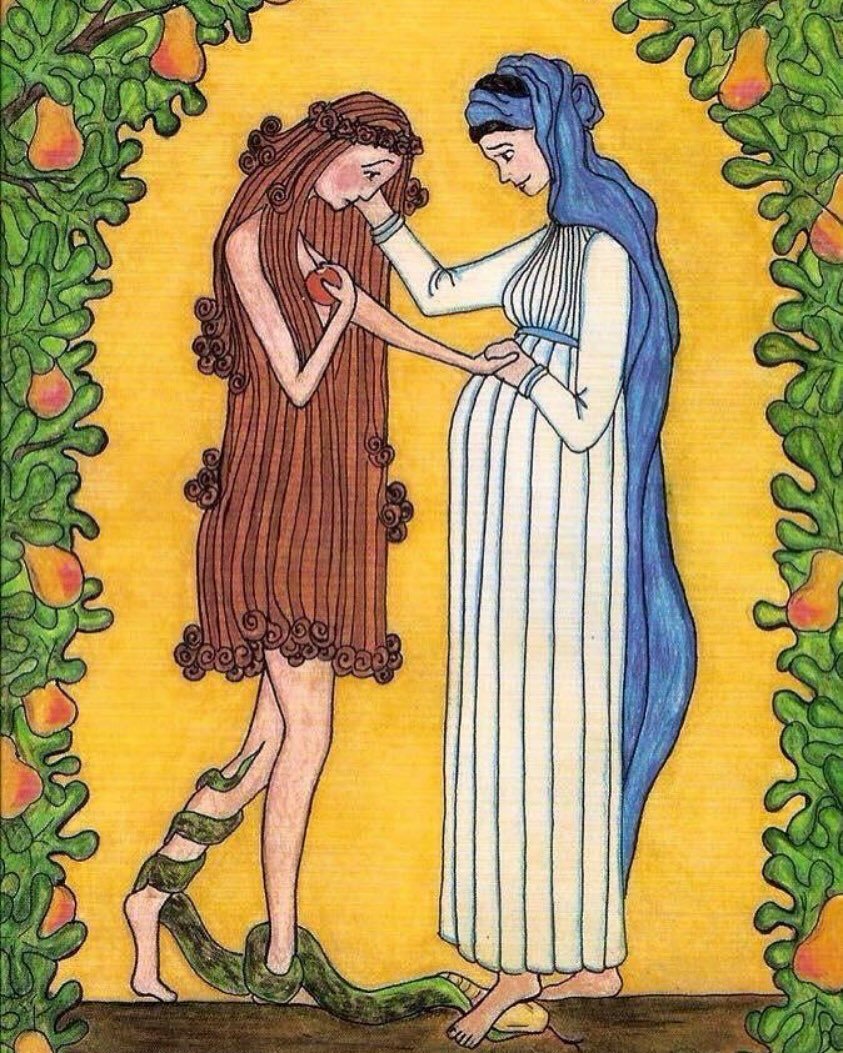
“Mary Consoles Eve” by Sister Grace Remington of the Mississippi Abbey
The contrast between Eve and Mary is a wonderful study. Take a look at this illustration done by Sister Grace Remington from the Sisters of the Mississippi Abbey.
Beginning from the top, we see Eve’s face looking down in shame, but Mary looks into Eve’s face with a reassuring smile and a hand on her cheek. Moving down we see Eve clutching the forbidden fruit that has brought all this ruin in contrast to Mary’s fruit of her womb that will be salvation for mankind. Then, at the very bottom, Eve’s leg is encircled by the serpent’s tail, but as the serpent moves towards Mary’s leg, we see her foot on the snake’s head.
Now, before all the Protestants get too worked up, keep in mind it is just an illustration and an illustration created by a catholic nun, so don’t let the artistic license get you too excited. Nevertheless, these contrasting characters show us the reason for Christmas.
Let’s continue our look at God’s love as sung by Mary.
Mary’s Song | Luke 1:46-55
Mary is told she will have a baby boy whom she will call Jesus, and he will be called “Son of the Most High”. Of course, she doesn’t understand how this can be possible since she is a virgin, but Gabriel says the Holy Spirit will come upon her. The child will be called holy because he will be the Son of God. It is possible for this virgin to conceive a child because nothing will be impossible with God.
Mary goes to her aunt, who also is having her own miracle baby, and the reality of her situation sets in. And then, Luke recounts what has become known as “Mary’s Hymn of Praise.” As we read it together, see if you can pick out the themes of Advent within the song.
And Mary said,
“My soul magnifies the Lord,
and my spirit rejoices in God my Savior,
for he has looked on the humble estate of his servant.
For behold, from now on all generations will call me blessed;
he who is mighty has done great things for me,
and holy is his name.
And his mercy is for those who fear him
from generation to generation.
He has shown strength with his arm;
he has scattered the proud in the thoughts of their hearts;
he has brought down the mighty from their thrones
and exalted those of humble estate;
he has filled the hungry with good things,
and the rich he has sent away empty.
He has helped his servant Israel,
in remembrance of his mercy,
as he spoke to our fathers,
to Abraham and to his offspring forever.”
Luke 1:46-55
Mary recognizes the world for all future generations will call her blessed, but not because she has earned it—the Lord has shown her immeasurable grace. She recognizes her humble estate, and the Lord has saw fit to raise her up.
She is experiencing the Joy that comes from the Lord.
Then, she says the Lord’s mercy is for those who fear him, and that mercy is from generation to generation. Mary knew, just like many many others in Israel, their country had fallen from their exalted position in the world. Israel was meant to be a light to the nations—a place where even the Gentiles could find salvation in the Lord, the One True God. But now they were subjects of foreign rulers with priests who were more concerned about keeping their political positions than serving the Lord. Even still, the Lord shows mercy by sending the Son of God who would take away the sins of the world.
Mary knew the Hope that comes from knowing the Lord and knowing He is still at work in this world.
She then goes on to describe the upheaval that happens when the Lord enters the scene. The prideful are scattered, the mighty brought down, and those who have been humbled by this world are exalted. The hungry are fed, but the rich are sent away empty handed. For those who trust in the Lord, there is a great peace that all will be made right.
Mary knew the Peace that comes from knowing the Lord is still on his throne.
Then, look again at verses 54 & 55. She recounts the Lord made a promise to Abraham thousands of years ago (and it would thousands of years for her, also) all nations would be blessed from the seed of Abraham. Israel exists because the Lord gave Abraham and Sarah the baby boy he promised them. And from that boy, generations of children came who eventually became Israel. And from this nation of people, we have the Savior Jesus Christ.
The Lord fulfilled his promise to bless the world with a Savior through Abraham with Jesus Christ.
Mary is beginning to understand the Love of God because she is helping fulfill the promise of the Savior for mankind. And this is the love that we celebrate today. It is a love that has action and accomplishes great things.
Experiencing True Love | 1 John 4:7-11
The most important aspect of biblical love is the fact that ‘love’ is a verb. It is not a thing—a feeling to share or to give. It is an action. We cannot say we are loving others if there is not action behind our love. The fullest expression of love this world has ever seen happened 2,000 years ago when the Savior came into this world and laid his life down for us.
John says it this way,
Beloved, let us love one another, for love is from God, and whoever loves has been born of God and knows God. Anyone who does not love does not know God, because God is love. In this the love of God was made manifest among us, that God sent his only Son into the world, so that we might live through him. In this is love, not that we have loved God but that he loved us and sent his Son to be the propitiation for our sins. Beloved, if God so loved us, we also ought to love one another.
1 John 4:7-11
As we consider this great love, John reminds us we cannot just sit by and feel love, we must act. So, how can we experience the love of God this Christmas?
First, to experience true love we must know God.
Not, do you know about God, but rather do you know Him? Have you met the Lord? Jesus Christ is called Emmanuel which means “God with us” because the Lord has made himself known. Jesus came to us so that we can know God Himself, not just know stuff about him. Get to know Jesus, and you will get to know your God and His love for you.
Second, we must trust in the saving work of Jesus Christ.
In verse 10, John calls Jesus the “propitiation for our sins.” Propitiation is a fancy word that simply means ‘substitute.’ Our sins deserve punishment. They are a plague upon our soul. Just as a virus will cause a body to break down, and if left unchecked death, so too does sin wreck havoc on body and soul. And if left unchecked, sin causes death—not just physical death, but spiritual death as well. Jesus came to take on the punishment for our sins by dying on the cross, and he rose again on the third day providing the cure for sin’s disease. Because Jesus lives, we can have forgiveness and cleansing of our sin. That is the love that God has for us. He sent His Son to us, to die for us, so that we can live.
Third, we express the love of God by loving others.
Verse 11 is such a loaded sentence. Just as God loved us, so too, should we love one another. The more we understand God’s love for us, the more we can love one another. Yes, there will be times when it is difficult to love, but that’s how we know we are on the right track and experiencing the true love of God.
If you want to experience the love of God this Christmas, then take stock in who you are already loving. Do you love the Lord? It’s very difficult to love someone you have never met. If you have not surrendered to Jesus this Christmas, let’s start there. Trust in the work that he has already done. When you surrender to Jesus, the forgiveness and life you find in him will overwhelm you with hope, peace, joy, and love.
If you have trusted in Christ, how are you doing on loving one another? Instead of concerning yourself with what you can get out of this season, concern yourself with what you can give—with who you can actively love.