
Joy in Remembrance | Numbers part 24
Today, we return to the Wilderness Wanderings in the Book of Numbers. As a reminder of how far the Israelites have traveled, I’d like to take a look at the map.
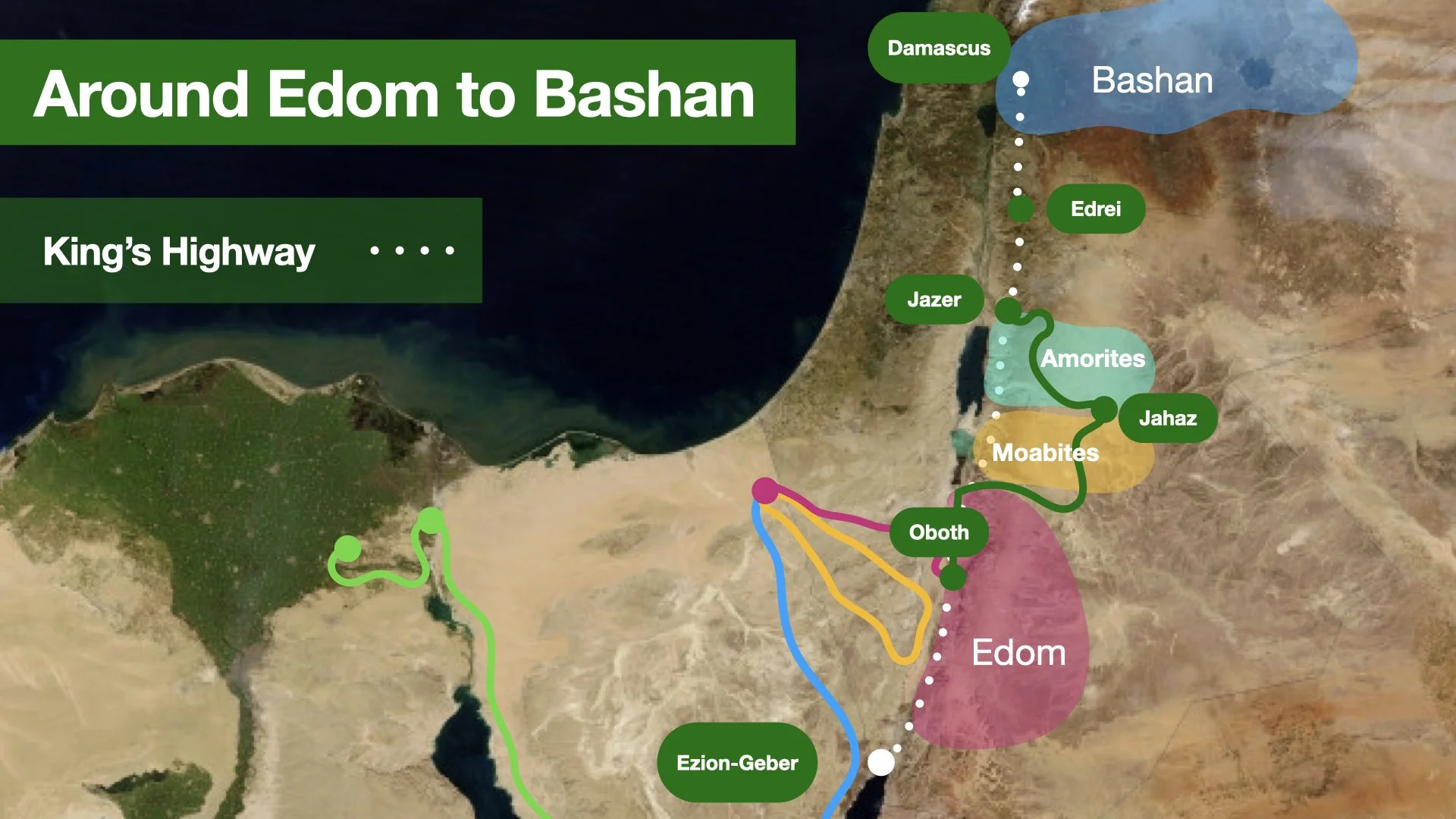
They have traveled for 40 years now and are headed towards the Promised Land once again. You may recall in Numbers 20 the Israelites were denied access to the King’s Highway by the Edomites. They opted to go around Edom which puts them on a far eastern route and further from the cities of the Transjordan area. It also will force them to march through more of the territory of the Moabites and Amorites than the direct route on the King’s Highway would.
On this route, the Israelites will once again face enemy kingdoms that will refuse travel on the King’s Highway, however, this time, the outcome will be quite different.
Joy in the Journey | Numbers 21:10-20
And the people of Israel set out and camped in Oboth. And they set out from Oboth and camped at Iye-abarim, in the wilderness that is opposite Moab, toward the sunrise. From there they set out and camped in the Valley of Zered. From there they set out and camped on the other side of the Arnon, which is in the wilderness that extends from the border of the Amorites, for the Arnon is the border of Moab, between Moab and the Amorites. Therefore it is said in the Book of the Wars of the Lord,
“Waheb in Suphah, and the valleys of the Arnon,
and the slope of the valleys
that extends to the seat of Ar,
and leans to the border of Moab.”And from there they continued to Beer; that is the well of which the Lord said to Moses, “Gather the people together, so that I may give them water.” Then Israel sang this song:
“Spring up, O well!—Sing to it!—
the well that the princes made,
that the nobles of the people dug,
with the scepter and with their staffs.”And from the wilderness they went on to Mattanah, and from Mattanah to Nahaliel, and from Nahaliel to Bamoth, and from Bamoth to the valley lying in the region of Moab by the top of Pisgah that looks down on the desert.
Numbers 21:10-20
For those wondering where the “Book of the Wars” is in your Bible, you won’t’ find it. This book has long been lost to time outside of the excerpts here and possibly Exodus 17:14 where God tells Moses to record the victory over the Amalekites.
Much of these verses is the travel itinerary giving us the general direction of the caravan, but we also get the origin story behind some of the lost Book of Wars and, more notably, the Desert Song of the Well. One notable commentator connected this song with desert Bedouins who sing a similar song:
Flow water, spread abundantly
Wood, camel, do not scorn it!
With sticks we have dug it!
It’s fairly impossible to determine how ancient the song and Bedouin well-digging ceremonies are, and so perhaps we still have remnants of this song today, or perhaps not. Either way, the fact that two bits of poetry occur back to back in the passage, and then another in the next section, lead us to understand this period of Wilderness Wandering is a joyous one.
They are on the final leg of the wandering headed to the Promised Land. They have survived yet another judgement from God, but notice, also, when the people wanted water, the Lord provided. There was no grumbling, no complaining, no desire to return to Egypt. It would appear they simply asked for water, and the Lord gave them water. The joyous tone of the text and the relative ease with which they receive water leads us to a principle of walking with the Lord:
Faithfulness to God may not change your circumstances, but it does change our attitude towards our circumstances.
They are still wandering. They are still headed through enemy territory. They are still dealing with building a nation as they continue to be nomads. And yet, now, because their faith has grown, and because they are walking in obedience, their attitude is one of joy rather than grumbling.
Before we move on, there is one more point to note. This Song of the Well comes directly following the ordeal of the bronze serpent. Now, we know the bronze serpent story points us to Jesus. Jesus was very clear about this point in John 3:14-15. Jesus also taught those who trusted in Him would also have a spring of living water flowing out of them.
On the last day of the feast, the great day, Jesus stood up and cried out, “If anyone thirsts, let him come to me and drink. Whoever believes in me, as the Scripture has said, ‘Out of his heart will flow rivers of living water.’” Now this he said about the Spirit, whom those who believed in him were to receive, for as yet the Spirit had not been given, because Jesus was not yet glorified.
John 7:37-39
Is it too much of a stretch to suggest the Messianic imagery of Numbers 21:4-9 can be carried over to verses 16-18? There’s certainly not the same 1:1 imagery of the bronze serpent, but it is worth noting in verse 16 the Lord says He will give them water (not Moses), and after they receive this water, they begin a military campaign that ends in victory. We know that Jesus went to the cross so that we can be saved. We know that when we surrender to Jesus in faith, He not only saves us, but He also gives His Spirit—who is the living water promised in John 7. Last, we know that through faith in Jesus and the power of the Holy Spirit, we can continue to see victory in our lives overcoming the enemy of sin and Satan. Whether or not this particular text is meant to mirror this pattern, it is certainly the same pattern we see. The Israelites are saved from the serpents by looking to the bronze serpent. They receive water—from a well that continues to provide water well into the future. They, then, see victory over those who would keep them from the Promised Land.
Victory in life begins in surrender to Jesus.
Remembering through Song | Numbers 21:21-30
Then Israel sent messengers to Sihon king of the Amorites, saying, “Let me pass through your land. We will not turn aside into field or vineyard. We will not drink the water of a well. We will go by the King's Highway until we have passed through your territory.” But Sihon would not allow Israel to pass through his territory. He gathered all his people together and went out against Israel to the wilderness and came to Jahaz and fought against Israel. And Israel defeated him with the edge of the sword and took possession of his land from the Arnon to the Jabbok, as far as to the Ammonites, for the border of the Ammonites was strong. And Israel took all these cities, and Israel settled in all the cities of the Amorites, in Heshbon, and in all its villages. For Heshbon was the city of Sihon the king of the Amorites, who had fought against the former king of Moab and taken all his land out of his hand, as far as the Arnon. Therefore the ballad singers say,
“Come to Heshbon, let it be built;
let the city of Sihon be established.For fire came out from Heshbon,
flame from the city of Sihon.
It devoured Ar of Moab,
and swallowed the heights of the Arnon.Woe to you, O Moab!
You are undone, O people of Chemosh!
He has made his sons fugitives,
and his daughters captives,
to an Amorite king, Sihon.So we overthrew them;
Heshbon, as far as Dibon, perished;
and we laid waste as far as Nophah;
fire spread as far as Medeba.”
Numbers 21:21-30
Earlier I mentioned the number of songs in this passage express the joy of victory and the overall optimism of this particular time in Israeli history. As we consider this particular song, I would like to also ask, “What songs do you sing regularly?”
Music has a particular role to play in our lives. It expresses emotion, creativity, and truth. For those who spend less time in creative endeavors, it can be difficult to understand how Art (whether in music or another media) can express truth. It will help to consider the hymns and songs we sing during a worship service. Why those particular songs? Why are some songs considered inappropriate or even heretical?
Musical worship is a form of discipleship and teaching.
We learn quite a bit through music. There is an experiment associated with musical teaching that grows out of date with each passing year, but here it goes:
West Philadelphia, born and raised…
Can you sing the next line? What about the whole song?
An entire generation grew up watching this television show, and because we saw it so often, we can sing this song with ease.
Music reinforces what we have learned, and that is why it is so important to consider the lyrics of the music that we listen to and sing. Arius, the great heretic of the second century, is believed to have begun his false teachings through music. Today, many songs promote themselves as “Christian” and yet their lyrics read as something else.
There is another bit of historical trivia that adds a layer of meaning with this text. Archaeologists have unearthed an Ammorite victory song that sounds very similar to this Israelite song. It would appear the Israelite who wrote this song reworked the lyrics of the Ammorite song in order to add insult to injury in their victory.
This phenomenon is found throughout history…even into modern times. Songwriters enjoy reworking tunes to match new messages. In church history, we can see the height of “Christianizing” songs in the 1800s. Many of our hymns from the latter half of the 19th century use the melody of folk songs so that congregants would know the melody of the song. The lyrics, of course, were reworked to teach sound theology. In fact, there is a rumor some of these hymns were based on saloon songs, but this is probably a misunderstanding of the term “Bar”. In music, a “bar form” is a particular meter, not necessarily a “drinking song.”
One particular example is from the Scottish hymn writer, Horatius Bonar, who wrote “I Heard the Voice of Jesus Say.” Mr. Bonar wrote this song to the melody of “Kingsfold,” an English and Irish folk song. The same melody can be heard in “O Sing a Song of Bethlehem” and “I Feel the Winds of God Today.” He purposefully used this folk song because he was concerned about the children in his congregation and their ability to sing the songs with the adults.
Now, I have taken this little historical detour to reinforce the point of our present text. Numbers 21 is a chapter filled with stories and songs to remind Israel of what God accomplished through, with, and for them. It is a reminder of why they sing the songs they sing. So, again, to bring it to today, I ask: What songs do you sing?
Music feeds the soul, and so we must ensure we are feeding our soul’s good music.
Victory from the Lord | Numbers 21:31-35
Thus Israel lived in the land of the Amorites. And Moses sent to spy out Jazer, and they captured its villages and dispossessed the Amorites who were there. Then they turned and went up by the way to Bashan. And Og the king of Bashan came out against them, he and all his people, to battle at Edrei. But the Lord said to Moses, “Do not fear him, for I have given him into your hand, and all his people, and his land. And you shall do to him as you did to Sihon king of the Amorites, who lived at Heshbon.” So they defeated him and his sons and all his people, until he had no survivor left. And they possessed his land.
Numbers 21:31-35
This last section sounds familiar, and yet very different. Here, instead of enemy kings rising against Israel and becoming a burden or source of fear, this king is defeated soundly…and literarily quickly. His story is only five verses long. The literal story is fairly straightforward, and so in the little time left today, I would like to draw out some of the deeper connections.
The literal historical enemies of Israel become spiritual symbols in Messianic prophecy, and in turn, teach us how we can approach our current struggles.
First, Bashan is an area known for its large bulls. Psalm 22 says,
Many bulls encompass me;
strong bulls of Bashan surround me;Psalm 22:12
By the time Psalm 22 is written, “bulls of Bashan” has taken a few different meanings. They are the literal, very large bulls of the area. They are also a symbol of Israel’s antagonists—civic and religious leaders who attempt to oppress the people. And, very important for Psalm 22’s connection with the crucifixion, they are metaphors for the demonic forces that persecute all people.
Second, Og is their king. He is certainly a literal king of a literal people, but he represents more. In Deuteronomy 3, we learn Og is also the last of the Rephaim—a race of giants whose name also gives them connection with the realm of the dead. Isaiah 26:14 translates the same word as “shades” which is a later meaning of the word. In the beginning and in the wider ancient traditions, Rephaim are giant figures associated with demigods. They are defeated by Israel and become known as powerless foes left in Sheol, the land of the dead. They were Israel’s oppressors, but now they are defeated opponents brought down by the power of God.
I mentioned Psalm 22, which refers to the bulls of Bashan, has messianic layers. Jesus begins quoting Psalm 22 on the cross when he says, “My God, my God, why have you forsaken me?” The bulls that surrounded Jesus on the cross were the religious oppressors, the Roman oppressors, and the spiritual oppressors of Israel. But every single one of these bulls is defeated by the power of God who rose Christ from the dead. Go back to Numbers 21:34.
But the Lord said to Moses, “Do not fear him, for I have given him into your hand, and all his people, and his land. And you shall do to him as you did to Sihon king of the Amorites, who lived at Heshbon.”
Numbers 21:34
Moses and the people are not to fear Og nor his army because the Lord has already given them into their hands. Just as Sihon was defeated so will Og be defeated. When we come to battles in our own lives, whether spiritual, emotional, or what, we can remember God has already given us victory.
The Lord can and will give us victory in our daily battles because He has already conquered sin and death.
As we face spiritual battles in our own lives, we tend to think of demonic forces and the sinful flesh as giants. They are fear-inducing entities that oppress us. The reality is these forces are already defeated. Jesus has already conquered them through his death and resurrection. The Rephaim in your life are not giants. They are shades. They are defeated enemies bound for death. We have no need to fear them any more than the Israelites needed to fear Og.